|
After you're finished your tour of the Web Site, you might
wish to read these trip reflections by the students and faculty.
Introduction to Reflections read
At the top of this page of our web presentation about this trip, a
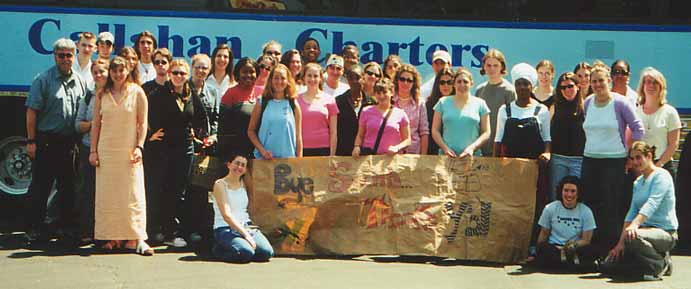
brief introduction appears. It is true that on April 15, 2001, 36
Lincoln-Sudbury students and four teachers traveled to the "Deep South,"
to follow the trail of the Civil Rights Movement, and to explore a world
beyond their own.
To this must be added a myriad of personal motivations. Just why do
students choose to go on a school-sponsored trip during one of their
vacations? To be sure, there were students who had developed a strong
academic interest in the Civil Rights Movement. More than half the trip
participants had studied the subject, and the trip may have seemed to them
a natural extension of their course of study. But there were also
girlfriends who wanted to be with boyfriends (and vice versa). There were
restless youth who perhaps wanted a brief vacation from parents. Take me-
anywhere! There were those--perhaps all--who were also hoping for
adventure, for excitement, for a chance at encountering the unexpected.
Beyond the history of the Civil Rights Movement, we found some of all of
these things, but we also found passion and pathos, emotions still warm,
and people so real you could just reach out and touch them. Or be touched
by them. We ended up traveling not only in pursuit of history, but through
the history actually being made as we traveled. As our bus rolled, old
confederate-inspired state flags were being challenged and juries were
being selected in a continuing effort to make just an unresolved past. The
trip was a powerful experience for most of us, adults included. But the
nature of that power, even now, is elusive and hard to articulate. Layers
were laid down. I'm not certain any of us have gotten to the bottom of it
all yet.
Upon our return, there was no transition period back to regular life as
we had known it. Lincoln-Sudbury demanded our instant attention. We flew
back on a Sunday, and the next day school resumed. For teachers, there
were classes to teach; for students, papers to write and tests to take.
How quickly even powerful experiences can seem to evaporate in the
non-stop flow of our lives. Oh, the South? Hey, that was last week.
The web site, the photographs, the music, the brief comments on each
page, the longer pieces of reflection which some students prepared, and
the documentary film which will soon be created--all these turn out to be
acts of resistance against forgetting, and a grand collective effort at
remembrance. Together, they say, as if in unison, "Once upon a time in
April, 2001, we took a trip together, and during that journey, there were
moments that seemed very important."
Here is some of what we remember.
Bill Schechter
Deep South Trip Reflections by Nicole Angueira read
A trip to the south that seems like an odd place to take a group of high
school teenagers during their April Vacation. Still, everyday walking through
the hallways at school, the bright yellow flyers advertising such a voyage
never failed to catch my eye. Eventually, I stopped to read. In a nutshell,
the flyer read, screw Europe and travel your own country. We had just
finished studying the Civil Rights Movement in class, and frankly, I was sick
of hearing about the states most thoroughly involved in the movement.
Furthermore, I had no desire to visit such states during my vacation. Lucky
for me, a few friends persuaded me to inquire about the in famous south trip.
After I gathered all the necessary information, there was only one thing that
stood in between me and Dixieland...my parents.
I will never forget the day I came home from school and asked my parents if I
could go to the Deep South on the school trip. My dads response, Why would
you want to go there? Sparked a greater desire for me to be a part of the
journey (it must have been that teen rebel thing showing up again!). After a
few days of my mom and dad discussing the idea, they reluctantly decided to
let me go. My dad, who grew up in a Puerto Rican neighborhood in the South
Bronx, is not exactly the most open-minded person I know, and I understood his
reluctant attitude towards the trip. Lucky for me, however, he put his
own beliefs aside and paid the money so I could go. From then on, there was
not a day that went by that I did not think about the upcoming trip.
As departing day quickly approached, I had mixed feelings about
the trip. Overall, I was excited, but I felt a bit nervous about traveling to
a greatly different culture and also a bit sad that I was not going to be home
for my last April Vacation with my friends. Yet, I was still anxious for
April 15th to arrive, and finally, it did.
We met at school on Easter Sunday at 2:15 in the afternoon. At
this point I could not wait to escape the boring town of Sudbury and finally
experience something new and different. As I boarded the bus with my
friends, I somehow knew that there was no way that I would return from the
trip the exact same person I was leaving as. Excitement overwhelmed me as we
drove away from the school.
My first impressions of the south came relatively soon after we
landed inMemphis. A few friends and I decided to get a meal at Chilis. We
ordered our food and patiently waited for it to arrive. We waited, and we
waited; we waited some more, and then after we were done waiting, we waited
even longer! No longer were we among the uptight, demanding, time-crunched
people of the north,but among the laid back, easy going, good-natured people
of the south.
The next morning, we arose early and drove to the Lorraine Motel,
the site of Dr.Martin Luther King Jr.s assassination. The motel was gutted,
except for two rooms, and transformed into the most amazing Civil Rights
Museum. As I walked through, the words of our tour guide captivated me.
Sometimes, when studying history, I find it difficult to associate myself with
the people of the specific time period I am currently studying. Being in
this museum made me feel like I was a Civil Rights Worker, fighting for my
rights,as well as the rights of thousands of others. The end of the tour
showed the two un-gutted rooms of the motel. One was the room that Dr.
Martin Luther King usually stayed in while visiting Memphis; the other room
was the room that MLKhad stayed in on his last visit to the motel. The latter
room has been kept in perfect condition, exactly how MLK left it before he was
killed. As I peered through the Plexiglas, chills ran up and down my spine.
The idea that a man so heroic and famous in my mind stood in the very place I
was standing and died in a spot I was merely ten feet from was shocking to my
soul.
Luckily,after the emotional trip to the Lorraine Motel, we were
off to Graceland. That was an experience within itself! First, we went to
the mansion. It is absolutely beautiful. When you first drive up, it does
not look big at all from the outside and then you go inside and it is
absolutely enormous. They give you a Walkman, and you go on a personal tour of
the house. After studying the influence that he had on rock and roll and
theAmerican population as a whole, it was incredible to see many of his
great achievements, such as his gold and platinum albums displayed with such
high honor. We also saw his private jet, the Lisa Marie. I would have
loved to travel to Tennessee on that!!!
The next day we traveled to Clarksdale, Mississippi, œthe place
where the blues were born. We went to a Blues Museum where we learned about
the history of the blues, listened to various blues musicians and saw
paintings, guitars and other memorabilia from famous blues artists. Before we
attended this museum, I knew almost nothing about the age of Blues but
reflecting back on the experience now, I realize that I learned more than I
can imagine during the limited time we were there. The woman who spoke to us
was authentic and captivating. For me, she really brought the blues home.
Then we went to a place called a juke joint. It is a place where people
go to hang out,listen to music, have a good time basically one big party.
After the blues, we went to a place called Hopson Plantation. It
is not in working condition now, but all the old buildings and houses are
there. For me, it was shocking to see the slaves shacks. Imagining that an
entire family lived in those tiny houses is truly amazing. The man who owns
the plantation is a professional junk collector and inside one of the main
buildings there is tons of the most random stuff on the walls. It did get a
little scary though because there were confederate flags everywhere. At one
point I had to use the bathroom, so I went and there were pictures all over
the wall. There was one picture of the man who owns the plantation in a Ku
Klux Klan outfit. It was very strange to see something like that.
Next,we drove to a small town called Mound Bayou. The town was
built and is currently run by black members of the community. I think it is
astonishing that through the struggles that the black population endured
during slavery and after, they were still able to build their own home and
maintain it for over one hundred years. While we were there,the mayor of the
town spoke to us. He gave us the entire history of the town and it was
surprisingly interesting. When we first arrived, it was unclear to me why
Mound Bayou was a significant place, but within ten minutes of hearing
theMayor speak, the reasons became quite clear to me. Sitting inside the
city hall, I could feel the strength and pride of the people who lived there
permeating the walls.
The next part of our voyage was the reason I enjoyed my week in
the south so much. We met with a man named Hollis Watkins. He was one of the
original freedom singers from the Civil Rights Movement. He was an incredible
speaker. He described his experiences at the demonstrations during the
movement and how they personally affected him. Before we even got off the bus,
I did not really want to goI wa hungry, tired and not looking forward to
another lecture. As we walked in and sat around in the tight-knit circle
of chairs Mr. Watkins had set out for us, I had a feeling inside my stomach
that this talk would be different. Immediately after he started speaking, I
knew that feeling would hold accurate. He started by telling us his personal
history and about the many demonstrations he attended. Then, he made us all
stand up and for about forty-five minutes, while we sang freedom songs,
holding hands. It was one of the most intense feelings I have ever had in my
life. Standing there with some of my best friends, sharing something so
special and so significant sent chills down my spine. I loved every minute of
the two hours we were there, and it was well worth getting off the bus for!
After all this history stuff we had been exposed to, it was time
for a little fun! We went to New Orleans!!! I have never been in such a fun
city. I am officially jealous of everyone who goes and is going to school
down there. Anyway, we had an awesome time. We ate in French cafes and
shopped for about four hours in the tiny shops on the side streets. Such
atypical girl way to spend the afternoon!!!
The next three days of the trip were my favorite (aside from
Hollis Watkins). We went to Philadelphia, Mississippi, where three civil
rights workers were pulled off the road, brutally beaten and murdered. We
spoke to the man who was the editor of the newspaper at that time. Never in my
life have I been so intrigued by someone who spoke so slowly. He told us his
personally story and understanding of what happened and how the community
reacted and responded. Later in that same day, we went to Meridian,
Mississippi to visit the grave of James Chaney, one of the workers who were
killed. A man spoke to us at Chaneys gravesite, and while he was talking, it
was the first time during the trip that I felt the need to kneel down and say
a prayer.
The next day, we were in Selma, Alabama. First, we walked across
the Edmund Pettus Bridge. As I watched our group walk in two lines,
side-by-side,I could not even begin to imagine the horror that had occurred
there not even forty years ago. I began to question myself as a person,
wondering if I had lived during that time, would I have the strength to do
even half of what many before me had done? Honestly, to this very day, I
cannot yet answer that question.
After the bridge,we went to the National Voting Rights Museum. The woman who
spoke to us while we were there had such an effect on the entire group and me.
She had a way of making her point without saying much. For example, when we
were sitting down in the room with the photographs of the famous women and she
was asking the girls what we wanted to be, it started to hit me that once
upon a time I could not be what I wanted to be. I would not have the money,
the intelligence or the opportunity to pursue my goals. That really scared me,
and I thanked God for giving me the opportunity to grow up in an age that I
can be what I want to be, and not what someone else wants me to be.
After Selma, we went to Birmingham. While there, we visited the 16th Street
Baptist Church, where four little girls were killed in a bombing set by the Ku
Klux Klan. We saw a movie (can't remember the name) that truly touched
my heart. I began to wonder what these little girls could have accomplished
had they lived. It made me sad for their death, yet I rejoiced for the
short lives they had lived. After the church,we went to the Civil Rights
Museum in Birmingham, which I found to be pretty much the same as the Lorraine
Motel museum in Memphis. After the museum, we walked through the park across
the street. It was incredible. As you walk through, you experience the
different horrifying events that occurred in Birmingham during the Civil
Rights Movement, such as the police dogs, the water hoses, children being
thrown in jail etc.
The last day was my eighteenth birthday so it was rather special. First we
went to the site of Martin Luther Kings Grave, and the church where he and
his father were once reverends in. Then we went to Atlanta and had an
awesome time. We shopped, again, went to the Coca-Cola museum and went to the
Hard Rock Cafe. It was a very relaxing way to end a very intense trip.
Ironically, as we toured the south expecting to learn about history, we
realized that it was not history, but merely part of the present, and the only
difference is that it happened a few years ago. What I mean is that while we
were learning all these new and exciting things, the same history we were
learning about was changing right before our eyes. While we were in
Birmingham, the jury was being selected for the trial of a man accused of
being involved in the bombing of the 16th Street Baptist Church. Soon after we
came home, one of the men involved in the murder of the three civil rights
workers died from a freak accident. While we were in Mississippi, there was
a vote held to change the state flag, considering it had a portion of
the confederate flag STILL on it. The idea that history is forever changing
really became clear to me upon reflecting on my journey.
Overall, my journey to Dixieland drastically changed my perspective on life.
Thinking about the thousands of people involved in the movement, what they
were fighting for, like I said before, it makes me question the strength of my
being. I can't help but wonder what I would do if I were put in ANY of
the situations that black Americans encountered during the sixties. Also, how
much of my will to fight would have deteriorated once Dr. Martin Luther King
Jr., the leader of the Civil Rights Movement, was assassinated. True, he was
killed towards the end of the Movement, but many continued to fight for what
they believed in. The trip also made me think a lot about death. About two or
three days into the trip, it was becoming crystal clear to me the number of
people who died fighting for their rights. At night, I started having
intense nightmares where I was one of the thousands fighting for my civil
liberties andI was killed doing so. These nightmares made me stop to think
about the things that I call tragic in my life. How could I be so
ignorant and naive to worry about petty things, such as having enough money to
buy my new prom dress,or get my hair done at the salon, while people were
suffering and fighting simply to be able to live.
The last thing that I took away from the trip, though may seem insignificant
to others is this: when I was a little girl, my father made it a point to make
clear to me that a handshake is worth a thousand words and that shaking
someone's hand in one of the highest honors a man (or woman in my case) can
receive. Why didI think of this in the south? While we were in the Voting
Rights Museum in Selma, the man who spoke to us, (I can't remember his name
now for the life of me!), captivated me. He was so involved with Martin
Luther King and the Movement; I found him and his actions astonishing. Not to
mention that after fighting for his civil liberties, he got on with his life
and became the superintendent of the public schools in Selma. After he
was done speaking, I walked right up to him (even though my heart was beating
a thousand beats per minute), put out my hand, told him how inspiring and
honest I found him to be, shook his hand and thanked him for taking the time
out of his busy schedule to talk to us.
Nicole Angueira A Reflection of the South by Reem Assil read
Introduction
"Freedom has always been an expensive thing."
-Martin Luther King Jr.
Freedom is Coming, I do believe
I will not be conquered, I will keep my strength
For God is on my side, and His will is mine.
Fire, blood, rage, grief, and despair
Where is that light, I fear the day
That I may forget,
That light shines within me, everlasting
And pure, it will shine for the whole world
To see, I do believe.
No more fear, I must be strong
No more anger, I must be the bigger man
If hate destroys, then love will mend
I do believe, one day my
Grandchildren will be rejoicing in the
Treasures of Justice.
They try to break us
Tell us that we were not men
That black is the color of evil
That we will amount to nothing
But I will not be broken for if
I must, I will die a man.
They hurt our children
They convince them that they
Are inferior. They laugh at them,
Spit on them, shout at them,
Cheat them, and isolate them.
I see the tears of defenseless
Children and I try to convince them
That everyone is a child of God.
No more, our children will be
Symbols of greatness, we shall
Overcome.
The ugly sea of injustice surrounds me
I swim in hopes that I will escape it
But my arms become tired
My legs exhausted, I wonder
Many times if I can go on.
But my soul is too proud,
My heart is too committed,
And my faith grows with every beat of it.
And though I feel that I am
Drowning in that sea of ugliness,
I look to the heavenly skies
And I know that glory awaits me.
My neighbors tell me to leave
That the North will give me more peace
That I will get myself killed
But if I die, I know that
I will have at the least died for something.
If I leave my home, they win
I put more power into the white man's hand
To lynch our children, to burn our churches
To vandalize our homes, beat our men, and
Rape our women, no I cannot do that.
If I leave my home, I might leave the terror
But the terror will not disappear
I will betray my community
For they will live that terror
And I I will live the terror of knowing.
No I will stay, I will pay that price
They stole my freedom, and I will take it back
For it is rightfully mine to claim, it is
My God-given right.
So I will pay the price for freedom
For it has always been an expensive thing,
And God is on my side, yes, He is
I do believe.
They teach us in school that history is always being made. As a lover of
history, I have always believed this. However, I have never had such
conviction of it as I do now. You have to witness history with your own
eyes, you must see for yourself what kind of impact people can have on the
fate of humanity. My experience down South has taught me that history is
like a novel with many unclosed chapters. Each chapter is needed, however,
to open another and change the direction of the novel. We should ask
ourselves, what would have happened if the North had not won the Civil
War? Or what would the fate of the blacks be in this country if courageous
slaves had not spoken up or if the Civil Rights Movement had not occurred
at all in the Sixties? The South is the way it is today because of
history's doing.
Another thing that I have learned about history is that it is a constant
meeting of the past and present. If a chapter is unclosed in a book, then
it is sure to be revisited later on. I witnessed this down South. At the
very time we chose to visit Mississippi, the case to adopt a new
Mississippian flag was denied. On that Thursday April 18th, the
Mississippi Supreme Court ruled that the Mississippi state flag, which
incorporates the Confederate battle flag in its design, does not violate
the constitutional rights of blacks. Is it a coincidence that in this very
week we were studying the
Civil Rights Movement in the state of Mississippi? And while we are down
South, news briefs about the church bombing in Birmingham emerge. The
trial suddenly reopens and Thomas Blanton, the defendant in this 1963
bombing, will be retried. In addition to the Birmingham trial, the
reopening of yet another trial involving a certain murder of three Civil
Rights workers in Philadelphia, Mississippi, is requested. Finally, we
come home to a newspaper article claiming that the Blues were dying in
the place where they were born! History never has closed chapters; the
past and present continue to meet one another. This was never more evident
as it was in the South.
Before this trip, I had given much thought to what I would take back with
me. The theme of the trip was the Civil Rights Movement. In school we
learn about the great men and women who led this movement. However, we
never fully comprehend what it meant to take on the responsibility that
they chose to accept. It was a responsibility indeed, for it is a
difficult task to put
your fears behind you even under the greatest terror. I knew the facts but
this alone was not sufficient. Prior to going down South, I wanted to know
that there was more to the issue of Civil Rights than what any person
could learn in school. However, I never expected what I found.
What did it really mean to be black in the South? We read about people
like Anne Moody and we sympathize for her. However do we fully understand
what kind of terror was imposed on her? We do not understand that terror
for we have never experienced that fear of death because of our skin
color. Living in the North, we are privileged. If we can somehow
understand how much terror faced so many courageous black men and women,
then we will begin to understand the spirit of the Movement. And the only
way to catch the spirit of the Movement is to see for ourselves what kind
of terror these people were battling. And so we begin our journey down
South, in hopes that we will find some answers to our questions.
The postcard at the Lorraine Motel gift shop in Memphis, Tennessee
illustrated the trail of the fatal gunshot and then the trail of Martin
Luther King's soul as it ascended to heaven. I pray to God that this
illustration is accurate. The beauty of the Lorraine Motel lies in its
incredible authenticity. The sight of the balcony where King was
assassinated is heartrending. One looks up at that balcony and realizes
that it was here where this great man's life was stolen but nevertheless
where his legacy was preserved. Truly, there are no words to describe the
feelings of those who pass the balcony that marks tragedy but it is easy
to recognize it, both in yourself and in those who clearly feel connected
to King's struggle for justice. As we neared the motel room where Martin
Luther King Jr. stayed, intact and pure, we saw the tour guide pray like
it was his last prayer. His beautiful brown eyes welled up with tears as
if he were grieving for his father. Perhaps King was a father to many in
his own way. He took care of is people, gave them a voice of hope, and
provided for them a source of inspiration.
The Lorraine Motel was kept in its original form so as to help visitors
feel King's presence as they enter the courtyard. Giving a personal
account, I can assure anyone that the realness of this place was affective
for it assured me that I was in the presence of true greatness. I had not
even
entered the museum when a sudden feeling of speechlessness came over me.
It was this place that ended King's streak of incredible speeches,
successful protests, uplifting rallies, and inspiring sermons. I imagined
what people must have felt in 1968. They would never hear his voice again
except through audio and video. They would never get the chance to meet
him now. Never
again could they see him stand again among so many with such composure.
They would never be able to touch him, shake his hand, tell him what kind
of impact he has made on their own struggle for justice.
One thing people knew, however, was that the power of King's words was
everlasting. They knew they had to use what he had taught so many of them,
to continue their struggle. They knew that King would want them to
continue, for the success of the Movement does not depend solely on the
greatness of one man but on the greatness of many. Even King said in his
lifetime that he had never wanted people to glorify him. He was a man
fighting for freedom just like any other person. I knew that there must
have been collective grief over his death. However, I also knew that
though the Lorraine Motel may have been the spot where King's life was
terminated, it was also the spot where his legacy was continued. In my
opinion, there was no better spot to put the Civil Rights Museum for it
lies with a spot that holds meaning to so many people. Thus it gives the
place the sort of energy and spirit needed to touch its visitors. And
ultimately, it celebrates men just like King who were willing to give up
their lives for justice.
Departing from Memphis, we head towards Mississippi, a land that is
difficult to describe with words. You enter the state and you enter a new
world. Living in the North, I have been under the false impression that
American culture was uniform. I admit that living in Sudbury most of my
life adds to my sheltered nature. I did expect a difference but I did not
expect the degree. I might as well have been visiting another country
because Mississippi made me realize that I did not know America as well as
I should have. If you wish to see the power of history and its mark, visit
Mississippi for this is a land that is clearly marked for all to see. In a
few days, we saw the place where the Blues flourished, the plantations
where the blacks slaved and sweat, and the facility that they built for
their own self-determination. We witnessed the juxtaposition of affluence
and poverty, the spirited face of a freedom singer, and a town tainted
with history of hatred and murder. It was much to absorb and reflect on.
But I knew that if I did not do this, I would never fully understand what
it means to live in this country.
We begin our journey through Mississippi with a taste of culture. The
Mississippi Delta, where the blues were born, awaits us. I was not
prepared for I knew nothing about the Blues. I went into the Delta Blues
Museum ignorant of this art form. However, I came out with a genuine
appreciation for the richness of black culture. We learned about great
musicians like Muddy Waters, John Lee Hooker, Big Mama, and BB King. I
have no doubt in my mind that much of the Blues came froslaves songs in
the fields, filled with words telling of their extreme suffering and
privation. I imagine that many of the blacks working on the field had
their early songs that later evolved into the Blues. The blacks gave voice
to the mood of alienation and oppression that prevailed in the South. It
is not surprising that the Blues were born in an area where blacks were
often forced to work on the levee.
As we sat in the Delta Blues Museum listening to samplings of great
musician's works, I closed my eyes and tried to absorb the Blues sound.
We heard the original sound of the Blues, free of Western adaptation. As I
listened, I noticed the free use of bent pitches on the guitar but
nevertheless the beautiful simplicity of the tone. The lyrics were
intensely personal. In a few minutesI heard lyrics that dealt with the
pain of betrayal, desertion, and unrequited love. This beautiful outpour
of emotion known as the Blues is a musical tradition that must have been
rooted in the black experience of the post-war South. The Blues struck me
as a form of oral history, a way to communicate the feelings of the past.
I was very affected and am thankful that I had the chance to be educated
about the importance of this great art form.
As we finished traveling through Clarksdale, we witnessed the dwellings
of African Americans on plantations. The movie that we watched the
previous night put us into the context of our next stop, the Hopson
Plantation. Everything laid intact for us to see. The tenement shacks were
many times no bigger than a single room. They were nevertheless filled
with life in their furnishing. The remarkable thing about seeing the
plantation was my realization of just how hard it was to live there. I
remember a segment of the movie where the lady talked about the pain and
agony of cotton picking. She described the sharpness of the plant as she
pulled the cotton out. There was no stopping for pain, however, for they
had a whole field to pick and they had to ignore the pain and pick that
cotton as fast as they could. I can imagine just one day of work on the
plantation under the sweltering sun and the arid weather. I also learned
that the workers were not finished until they picked out enough seeds in
the cotton to fill a boot. This shocked me for the size of one seed is
equivalent to an ant! No complaining was allowed, for when one has to
survive, life itself becomes a luxury.Our next stop was Mound Bayou. Prior
to visiting it, I was unaware of this place and its historical
significance. Mound Bayou does in fact have a
special place in the history of Mississippi and the entire United States.
It was a successful social experiment that illustrated to the entire
nation that African Americans deserved respect and equal treatment. It was
one of the first all-black incorporated towns in the United States,
established by
slaves with great dreams. They wished to create a refuge for blacks in
this area of many white-controlled cotton plantations and at a time known
for racial violence. Not only did it provide for them a physical sanctuary
but it instilled in its residents a sense of racial pride. I was amazed by
its
great success.
However, something struck me about this place as well. I learned that the
residents of Mound Bayou did not see themselves directly involved in the
same fate as those leading the Civil Rights Movement. The mentality was
that African American freedom and the promise of emancipation could only
be realized in a segregated space, meaning blacks did not need the
collaboration of whites in their pursuit of self-determination. They knew
that they could achieve it alone and they did exactly this. By the time
the Civil Rights Movement erupted in the Sixties, they had already seen
themselves as liberated. They achieved that kind of self-determination in
their own community, the kind of self-determination that blacks everywhere
in the South lacked. I had never considered this , that once not all
blacks were fully connected to the Movement.
As we entered Jackson, Mississippi I looked around and I was astonished
to find the state's capital to have official buildings standing tall and
proud side by side with nearly run down homes. It was almost as if two
worlds were standing side by side in the same city. It was the most
extreme juxtaposition. Was the city unaware by the huge visible gap
between affluence and poverty? This was one question that was never
answered sufficiently.
In Jackson, we met Hollis Watkins, a former freedom singer and still
active Civil Rights worker. He heads the nonprofit organization Southern
Echo, which provides young African Americans with the skills they need to
advance themselves in society. It focuses on community building and
providing a strong framework for education. This man was by far the most
enchanting of the people I met on this trip. Very few have the ability to
capture the spirit of the Civil Rights Movement. This man had that ability.
He taught us freedom songs, shared with us his story, and showed us what
real fear and courage meant. He told us, "We were being killed anyways,
so
we should at least die for something." The whole time I wondered how one
would be so willing to put his/her life on the line. Hollis Watkins
assured us that people had such an immense faith and God and conviction
that He was on their side that they believed that He would protect them.
In fact, spirituality was on of the driving forces of the Movement because
it gave them power to overcome the fear imposed on them by the terror in
the South. Another way people overcame the fear of standing up to
injustice was to know that they were no alone in the struggle. People like
Hollis Watkins knew that they were not the only ones fighting. Thus, the
unity of blacks in their struggle to overcome was crucial for their
success.
Hollis Watkins did not share many specific facts about the Movement but
he taught me more about it more than any class could, no matter how good
the teacher may be. He conveyed the spirit of the Movement to us. He
engaged us with his spiritual freedom songs. We sang songs like "Been Down
into the South" and "We Shall Overcome.î As we were singing,
I felt so
uplifted. We were singing freedom songs and I really felt as though I was
singing for my own freedom! These songs were not only specific to the
sufferings of African Americans but also universal to the rights and
dignity of every human being. The freedom songs also made me appreciate
the courageousness of the ordinary people involved in the movement. The
Movement required bravery and sacrifice not just from the heroes we know
but from the ordinary people, who had their hearts committed to lifting
one another's courage everyday. Hollis Watkins told us that song was
embedded into African American culture; it possessed themes to which all
of them could relate. Therefore, it was needed to add the spirit and
momentum to the Movement.
I will never forget Hollis Watkins, his bright smile, cute face, and
lively speech. He was one of those ordinary people who were willing to put
their lives on the line if it meant helping many others lead their lives
several steps closer to social justice. He knew what kind of terror he was
up against but he was willing to overcome that fear and help others do the
same. And here he is today, president of a successful organization, and a
living breathing inspiration to many young people such as myself. If I had
the chance to speak to him once again, I swear to anyone who asks me, I
would jump at it in a heartbeat. My journey continues and not even Hollis
Watkins could have prepared me for what I felt in Philadelphia,
Mississippi.
It is important to understand the events that lead to the present state
of Philadelphia, Mississippi. It started the fatal summer of 1964 when
three civil rights workers named Andy Goodman, James Chaney, and Michael
Schwerner came down to investigate the burning of the black Mount Zion
Methodist Church in Lawndale. At three o'clock PM, they were stopped by
deputy Cecil Price near Philadelphia. They were taken to jail for speeding
and released later that night. When the men never phoned Freedom Summer
headquarters, people suspected that something was terribly wrong. Freedom
summer workers were supposed to call at regular fifteen-minute intervals.1
The men remained missing, and the town remained quiet.
What made the town react in the way it did? Was there conspiracy of
silence? People were not willing to admit the possibility of murder. When
asked, the Sheriff Lawrence Rainy responded, "If they're missing, they're
just hid somewhere trying to get a lot of publicity out of it, I figure."
The disappearance of these men did in fact attract the attention of the
nation. But many Philadelphians would not speak and many were convinced
that it was all a hoax. A known segregationist had told a reporter, "when
people leave any section of the country and go into another section
looking for trouble, they usually find it." One author pointed out, "The
cry of a hoax seemed a reflexive reaction, an expression of the region's
inability to recognize the ungentlemanly truth about its own racial
attitudes or the murderous excesses of some of its citizens." They did
not
want to believe these things and they did not want their town to be
defamed...
...It is now thirty-seven years later. What has become of Philadelphia,
Mississippi? Little has changed since the days when newsmen and television
crews covered the aftermath of the crime that put the tiny community of
Philadelphia into the world's headlines. One author writes, "Many of the
same barbershops and drugstores and banks that looked out onto the square
the summer evening Edgar Ray Killen and Barnett kept a rendezvous with a
careful of Meridian Klansman remain today. On the square's shaded
sidewalks, visitors still receive a penetrating glance from local
residents.' I felt those penetrating glances. I have the feeling they knew
exactly why I was there. They knew it was because of the unfortunate
murder that tainted their town's reputation. They want to do anything
possible to forget.
It is sad in a way for the Philadelphians because they will never be able
to erase history's mark. They cannot deny what happened there. But the
were angry because they were pitched as a city of murderers. The mayor
Charles McClaine said in 1984, "To me, it was sort of like a plane crash.
It was just a part of history that happened near Philadelphia, and there's
nothing we could do to erase it. However, the community, although not
directly, was somehow involved in that murder. Their conspiracy of silence
made them just as culpable as the Klansmen who pulled the trigger at the
three brave civil rights workers.
When she visited Philadelphia, Patsy Sims was able to articulate some of
the things I noticed and felt:When I visited Philadelphia in 1976, Price
was making deliveries. Most of the others were 'out',î too, or preferred
not to talk, trying to forget the past. Blacks and whites passed on
sidewalks, patronized the same stores, sat at the same lunch counters. Yet
I sensed the underlying tension between the two races, an unspoken remnant
of the past, a black should not get too far out of his place. There seemed
still a hostility in the town's visible effort to forget.'But the
inevitable truth is they have not forgotten. They will always be reminded.
And a chill went down my spine as I thought of Price walking around on
sidewalks of Mississippi doing another truck delivery, leading a normal
life as if nothing had happened. As I passed white faces, I did not know
who was a hater and who was not, there was no way of distinguishing. All I
could see was penetrating glares and I suddenly realized the profound
effects of the power of history. This town will always be a curse to some
and a lesson to others.
It was difficult to leave Mississippi knowing that there was so much to
be covered. I would have never guessed the atmosphere in Mississippi in a
million years. It was a revelation indeed. As we headed through Alabama, I
started to find a theme forming in this trip. For the first part of the
trip we had been given the context of the Civil Rights Movement and what
the struggle was all about. We had been shown exactly what African
Americans had been subjected to and the deep- rooted issues of racism in
the South. It was far more complicated than I could ever imagine. Racism
is still alive and well, I discovered. Why did I think otherwise? Perhaps
it is more inconspicuous in the North and more blatant in the South.
Whatever the difference was I knew that I could not even begin to imagine
what it would be like growing up black in the South.
The theme of Alabama would have to be empowerment, especially of the
youth. We visited Selma and the Voting Rights Museum and one of the things
I learned was that whatever I am going to be in life, I should be the best
at it. And I must use my profession to somehow contribute to society, for
I have the ability and more importantly the obligation. People marched on
Bloody Sunday so that African Americans could have the liberty to vote
today free of fear. Similarly, movements such as the women's movement made
it possible for women like me to pursue professions that were unimaginable
thirty years ago. I must take full advantage of this privilege. If we let
those people devote their lives to making our lives more privileged all so
that we can waste our blessings, then we should feel ashamed of ourselves.
I have an obligation to give back to my society and I hope that I will
have made the people, who fought for the security of my rights, proud. As
the reverend who walked on the frontline told us, "Just look to God. He
will make it possible if you can keep your faith." Perhaps I will use
that. It takes much humbleness out of one man to say that all of his
struggles and victories are at the hands of God. He was a voice of
inspiration.
My trip down South was a wake up call. I came back feeling a deep
connection to God, to my peers, to history, and to the world around me. I
have come back with this amazing determination to walk in the footsteps of
those who have indeed made momentous changes. It can be done, we do have
the power to make history. But I have also realized that it will require a
lot of work to sustain this feeling of empowerment. I cannot give in to
the sudden feeling of helplessness. I know that this is just the beginning
of my personal journey of discovery. Even before this trip I knew that I
wanted to be socially active but I felt that I had a long way to go for I
was too young and not educated enough. However, the people that put the
Movement into full gear were in fact the vibrant youth! Meeting and
learning about a lot of these young activists in the Sixties made me
realize that activism has no age requirement. The only thing initiation of
change depends on is how deeply your heart is committed. I can proudly say
my heart is more committed now then it has ever been.
Reem Assil
Deep South Trip Reflections by Lauren Barth-Cohen read
I don't remember a specific reason why I wanted to go on the trip. It
might have been a whim; it might have sounded cool that particular day Mr.
Schechter brought it up in class. I had a vague notion of civil rights
history, and about learning as aspect of American history, in the area it
effected most, but the main reason I wanted to go was to see a new part of
the country. As stupid as this may sound, I want to have visited all 50
states, and I'm keeping a running tally. After the trip it's up to 22.
I'd had this romanticized image of the Deep South before the trip. I think
It was mostly shaped from a couple books I've read, To Kill a Mocking
Bird, Anne Moody, Huck Finn, and As I Lay Dying, by William Faulkner. And,
one movie stands out in my mind, Forest Gump. I've never seen Gone with
the Wind, the traditional southern movie, but I've absorbed its message in
American culture. In Forest Gump there was these great scenes of giant
trees and sweeping green lawns and hot summer nights where the breeze
flowed through the curtains. In many ways I was expecting to see all the
things I had imagined in these media pieces; but I also knew that they
were 'fake' images and that reality was going to hit me.
<DIV></DIV>I wasn't expecting the airport to scream of the south.
I've
been in enough by now to realize that air ports all look the same,
unfortunately. The first night, when I went to eat at Chilis Restaurant,
(I think) I was a little taken aback. In my mind I had just landed in some
place I had never been before. Well, I wanted food I had never had before
too. However, then I came back to reality and realized that it was late at
night, people were hungry, and most important, chain restaurants livid in
the south too. Some how I had been keeping up a faint glimmer of hope that
chain restaurants didn't live in all parts of this country. I still have
28 states to go.
Over the whole week I found myself acutely aware of the L-S world that
lived inside the bus, and the southern world that existed outside the bus.
When we were stranded on the bus for long periods of time, all the
students would engage in typical teenage activities that were similar to
activities we did at home, gossiping about friends, discussing college
plans, listening to popular music, playing car games etc. Therefore in
some ways it felt as if the bus was an extension of L-S, and our everyday
normal lives. However, when we exited the bus to visit a sight, museum, or
listen to a guest speaker, we were no longer in the familiar world of L-S.
It felt like all these important issues and events involving the civil
rights movement occurred outside the bus, and inside we were just a bunch
of teenagers doing stereotypical self-centered activities. Although, we
did occasionally watch movie clips about the civil rights movement, it was
still a minimalist effect, compared to all the hours of gossiping we
participated in. By the end of the trip I found myself feeling very
fragmented. I'd had seen all these amazing things and was trying
desperately to digest and make sense of it all; but I still found my
friends absorbed in what shoes they were going to wear to the prom.
I think other students were aware of this persistent irony, and may have
dealt with it on their own; I too found a way to deal. Some may have
belittled its effects my talking with their friends about the places and
people we meet, but by the end, I wanted to get out of the bus, and take
public transportation more then I have ever wanted to in my life. (In fact
I don't know if I have ever really wanted to take public transportation
before) On the last full day in the south, Maggie, Emily, Fletcher,
Graham, and I took a walk out of the main tourist section of the Coca-Cola
museum and walked towards the CNN studios and Sentinel Park. While at the
park we joined lots of little inner-city kids playing the water fountains.
The fountains were on a cycle of lots of stronger and then less forceful
amounts of water, that repeated every 5 minutes or so. When the water had
slowed down Maggie ran into the middle of the fountain, she was the only
white girl there, and by far the oldest, as most kids barley came up to
her waist. When the water suddenly came on in a forceful manner she was
trapped with a strong wall of water all around her. After her initial
freaked out reaction, and hoping to avoid getting totally drenched, a
small soaking wet girl standing near by saw Maggie's fright and offered to
step on one of the spouts so Maggie could get out of the fountain semi
dry. Myself and the three other remaining dry L-S students were standing a
distance away, laughing, with our camera aimed at Maggie, and when we shot
our pictures, I don't think we ever expected to capture that simple act of
kindness from a stranger.
<DIV></DIV>Although we came to the south expecting to learn about
civil
rights history, this one incident opened my eyes to something I had not
noticed before. I had previously spent lots of time starring out the bus
window, wondering if I would see any racism, but I never thought to look
and see if I would see any actions that would give me the impression that
the southern mannerisms had changed a great deal. I also saw from this
incident that at 18 I could still safely pretend to be a child. However,
as we all know, children see the world differently, that little girl
didn't seem to notice that Maggie was white, and spoke funny. But I do
notice when some is a different color then me, and I am aware of other
accents, so I wonder, can I still be a child? Or have I lost that
indifferent or innocence long ago?
The stop that I think I enjoyed the most was the Cheney grave. Everything
I had seen in the south up till that place had existed on pavement and in
a street corner. Being in the woods, in the field, with the bugs, ticks,
etc, while viewing his grave, gave me a glimpse of nature in the south.
Some who I felt that what I most needed to do was walk in the woods, and
say to myself, I'm no long in New England woods, I'm in Southern woods. I
wonder if I were to close my eyes, and then forget where I was, could I
figure out I was in the south? Or would the woods look the same?
Unfortunately, I didn't greatly enjoy some of the speakers we heard. But
the ones that I found most interesting involved that day in Philadelphia,
and the man who spoke to us at the Cheney grave. Often I find it hard to
connect with speakers; some of the historical events they discuss seem so
far away, in the past, and geographically. But in Philadelphia, I was able
to connect with the guest speakers. I loved hearing them talk of an event,
and then looking out the window, knowing that the three boys, dept.
sheriff, and all the towns' people had been to the same Library. The
realization that the person in the soda fountain has witness a part of
history, or the guy we passed on the street might remember where he was
that day make me feel like I am experiencing something much more alive
then any other experience I have had with history. The man we talked to in
the Library was especially emotional about the event, and all of us could
sense his feelings and pain about that era. However, he was also an old
man, and us, being teenagers, unfortunately can have a hard time
understanding a person who has seen so much more in life, then we have yet
begun to experience.
At one point in the trip, I don't remember when, someone asked our group
if we had experienced much racism in the south. Myself, similar to most of
the students probably shook my head and said 'no,' but Ms. Stewart said
'yes.' At the time I thought about it for a minute, and then forgot,
continuing with my normal thoughts. However, on the morning of the last
full day in the south I asked Ms. Stewart what she had experienced. Her
answer surprised and shocked me I was expecting a very tangible
experience, similar to stories I had heard in history class, and in the
newspaper. She said that she had noticed when we (36 students and 4
adults) were places she had felt looks from southern people. She had felt
that in restaurants and stores that people were looking at her in a
'racist manner.' I did not understand what she meant at the time. Were
people staring funny? Giving her the evil eye? Making her feel
uncomfortable? Like she wasn't welcome? Or was it because she was with a
group of predominantly white kids? Did southern think it was queer to see
an African American teacher with mostly white student? I don't know which,
if any of these things were really occurring. Or was it slight paranoia?
What I have been able to figure out is that I don't know what it feels
like to be made uncomfortable in a public establishment. Sure, a couple of
times I've been made to feel uncomfortable by my embarrassing parents, or
a male who stares to long at a females chest, but those are not the same
things. There is that quote by Emma Goldman that fits in really well with
this idea, (on the wall of the classroom) which I can't remember. But I
think that I do understand that some aspects of the trip and places we
went the civil rights movement and of history in general, I will never be
able to understand as long as I live in my current skin. I can learn all
about them have sympathy, compassion and sorrow for what happened, but I
will never truly understand what it felt like to have it happen to me
because I was not there. With a historical event there are facts, and
places, and people who could teach you all about what happened, but to
feel what they truly felt is near to impossible. I don't know if I will in
time, with more life experiences be able to understand and reflect with
greater clarity and depth, possible. Maybe then I will be able to have a
complete understand on how this trip influenced my life, but I am still
working on it, maybe when I figure it out I'll write another reflection
paper. But, Mr. Schechter, thanks for taking us on the trip, it was a
wonderful experience I will never forget. I hope other students had as
positive time as I did, and I hope future student will experience it to.
Lauren Barth-Cohen
Deep South Trip Reflections by Jessica Browne read
Saturday, April 15
There was excitement in the air as I arrive at Lincoln-Sudbury Regional High
School. I have been anticipating this trip since I heard about it from Mr.
Schechter in the beginning of the school year. I had wanted to go on a
school trip but did not want to go to a different country, because I would
rather do that with my family. I wanted to do something that I would never
again have the chance to do again. Never would I think of taking a trip to
the Deep South to follow the civil rights movement. I knew that this was the
trip for me. I was also interested because I knew the basic facts about the
movement, but I wanted to see the sights, and maybe meet the people.
I could not believe that the day had finally arrived when I went to meet
the bus. I did not know what to expect, but I knew that it was going to be
fun. The bus ride seemed to fly by, as did the flight, before I knew it I
was in Memphis, Tennessee.
Monday, April 16th
We woke up pretty early to make sure we had time to see everything there
was to see. Our first stop was the Lorraine Motel and the National Civil
Rights Museum. This was one of my favorite sights on the trip. It was
amazing to see where Martin Luther King was shot. The museum was excellent
also. It covered many of the same facts that we had learned in Post War and
it had many more that were interesting too. The museum seemed to cover
everything; it even had a pretend bus. The bus was supposed to be the famous
bus that was bombed during the freedom rides. The museum had video clips
playing all over it. Including the more famous clips, for example Martin
Luther King's "I have a dream" speech and less famous video coverage
of
Birmingham. We were able to see the room that MLK had stayed in on the
fateful night; the owners had not changed anything. The room had a double
bed that was still messy, and the "food" left over from that morning.
It
seemed as though the room was the same as the day he died. They also kept
the room he usually stayed in. By the room he stayed in the night before he
died were two photographs. The first photograph was when he was a making a
speech on the balcony of the Lorraine Motel, and the second picture was right
after he was shot. This photograph was terrible to look at. I had never
seen this picture before and it was bizarre. Those photographs were taken
with in minutes of each other, and in those minutes, a tragic death occurred.
They also had two of the cars that were in the parking lot. The museum
really encaptured what the civil rights movement was all about. Even thought
I had heard all of the facts it made them more lifelike and I think it opened
many people's eyes.
We visited Graceland that afternoon. I had a different idea of what it
was going to be like. I thought that it was going to be all on one large
property, but actually, there was a major road splitting the house from the
rest of the amusements. When we took the bus over to the house, it was
weird. The house was not exactly what I thought it was going to be. I
thought the area was going to be larger and the house was going to be bigger.
It was cool because we were able to see what the house looked like when he
actually lived there. The mirrored walls and the shag carpets. Everything
seemed to be made out of gold. The television room was cool because there
were three of them and you could watch three shows at once if you so wished.
I liked the jungle room the best in the house. It had carpet on the floor
and the ceiling. There was a waterfall, and the chair was definitely my
favorite. I thought that it was very special the Elvis and his mom and dad
were buried on the property of Graceland. The inscriptions were lovely and
the garden around the burial sights was spectacular. I thought the eternal
flame was cool because I had never seen one before. I am impressed by the
fact that they could even do that. We also looked at Elvis's two airplanes.
I was very impressed by the decorating. The fact that he had 24 caret gold
belt buckles was amazing. The gold sink was also very impressive. Everything
was decorated so lavishly, I think it would be fun to be able to decorate
your own plane. Everything about Graceland was different than I expected.
It was a great experience because it is a place everyone should visit at
sometime or another.
Tuesday, April 17th
We arose early and headed off to the Delta Blues Museum in Clarksdale.
Mississippi was where the blues were born. The person in charge of the
museum played some CDs of blues music. We were able to listen the first
blues singers, and then we heard some other singers that we were familiar
with. After listening to some amazing blues, we were able to look around the
museum. It had pictures, and farm machinery, dolls, and everything else
imaginable. I think that the most interesting thing was the wax sculpture of
Muddy Waters. It was so lifelike that it scared you the first time you
looked at it. It seemed as though the eyes were following you around the
room.
Not connected to the museum, but right next to it was a refurbished bar.
This is like a place where the black people in the town would go to at night
to listen to blues and talk with your neighbors. It was a place where they
could congregate and not feel the pressure of the white people. We were able
to go inside it before it was completely finished, and it was cool. They had
decorations, a couple pool tables, and a place for a band to play. They
actually might record blues singers there. I think that it was the novelty
of being able to go and look at it, before it was open that really impressed
us.
The next place we stopped was an old plantation, Hopson Plantation. We
went into a large room, which is a bar, as well as a place where the owner
stores all of his antiques. The owner talked to us a bit, and then we were
able to roam around that room, in the tenant farmers houses, and around the
property. Walking around that room was interesting. I saw many interesting
artifacts, but the thing that surprised me the most was the amount of
Confederate flags. We counted over 15 in this room. There was a big flag
hanging from the ceiling as well as little flags scattered around the room.
It was frightening because people who have Confederate flags are usually
racist, and I would never want to spend anytime with anyone who believes that
they are better than people with different colored skin. Outside was
beautiful, with a fountain, large lawns, and fields surrounding the property.
We went into an old tenant farmers house. They were tiny, there was no
where to actually live. I cannot believe that they could stand living in
those quarters. He told us an interesting story. He said that the people
who lived in these houses covered the walls in newspapers. He had presumed
they did this for insulation, but he was told just a little while ago, why
they really did it. They thought that spirits were curious and if they had
nothing to occupy themselves with, they would hurt the people living in the
house. So, in order to keep the spirits amused they put up newspaper so the
spirits could read them and not bother the occupants of the house. This
story really stayed with me because the owner was oblivious to what the
tenants believed and because the story was fun. I love learning about
different theories that different cultures and people have.
This was the day that we met and talked with one of the most interesting
people on the trip. His name is Hollis Watkins, and he was a freedom singer.
He started off by talking to us about the movement. He talked about how he
got into the movement, and what had happened to him. His parents did not
want him in the movement but he went against their wishes and joined anyway.
He was an alternate singer. So when one singer could not go he was there to
help. He sang quite often and loved it. He was so much fun to talk to
because he was so passionate about the movement. He is still working to help
black people get the rights they deserve. He works for a group called
Southern Echo, which works to help the black people receive the same rights
that the average white person receives. He never gave up his goal of helping
his race and people who are less fortunate than he is. The best part of the
visit was when he stood up and decided that it was time for us to start
singing. He taught us a song, before long we were singing, and we did not
sound very bad. He was able to get all of us involved and made all of us
feel good. We were all so impressed and taken aback by his energy we did not
know what to do at first, but before long we did not want him to stop. He
had us so enthralled with every word that came out of his mouth. The best
moment of all was when he had all of us cross our arms and hold hands. He
began the theme song of the movement, and it made me feel as if just singing
makes a difference. I felt that it did not matter what was happening in my
life all that mattered at that moment was singing and that one day we all
shall overcome. I left that building feeling that we all need to help people
who are struggling, it does not matter how old you are or how young.
Everyone can help in one way or another, even if it is just lifting
everyone's morale by singing.
Wednesday, April 18th
We all had fun this day. We were able to do our own thing in the French
Quarter of New Orleans. We had had a very structured trip so far, where we
could only stay at one place for an allotted time. This day was much more
relaxed and we could go at our own pace. We were able to walk around and
take in the sights. There was a lot to look at and there were many shops.
There were shops that are standard, for example Banana Republic and Virgin
Records, but there were many other boutiques that were very fun. The gardens
were spectacular the flowers were in full bloom and had a lot of color. We
were able to lie outside and look at the people who were all around. It was
nice to be able to relax because we had been non-stop since we had all
arrived at school. The food was amazing. We ate in a little French café
and it was perfect. We had had fast food the entire trip so this was a major
treat. In New Orleans, there are many street performers. I saw a man who
had metal all over his body and I saw an angel. They would move if you gave
them money, but otherwise they would stay perfectly still. You could also
get your palm read or a fake tattoo. At times it was a bit nerve-racking,
because we had strange men come up to us and try to talk to us. We had to
make sure we did not get ourselves in trouble, and we had no trouble with
them. All in all New Orleans was one of a kind and fun to see.
Thursday, April 19th
We talked to another amazing person; he was a reporter when the three
civil rights workers were killed. He knew so much information and could have
talked for much longer. He had so much to say and everything he said made an
impression. You could tell that it hurt him very much to think about those
innocent people who were killed. He even said that he had thought about it
everyday for 30 or so years. He knew the men who had killed them, and often
still saw them around town. It was hard for him to see them and know they
were not punished as badly as they should have been. It seemed to be the
same everywhere we went, everyone we talked to still carry the memory of the
movement, and some are continuing their work.
We also went to the grave of James Chaney. Obie Clarke, who had a lot to
say about Chaney, brought us to it. This was one of the most touching parts
of the trip. James Chaney's grave was on the top of a hill in the middle of
nowhere. It seemed to be in the middle of a field with the forest
surrounding it. It was a gorgeous place to put him to rest. He does not
deserve to be put in a crowded cemetery, but to put in a place that is
special. When Obie Clarke was talking to us, he got very choked up. James
Chaney and what he was fighting for is very special to him, and he wants to
do anything and everything in his power to keep Chaney remembered. He was
telling us about Chaney's grave and what people had done to it. For a long
time, there was not much of a gravesite. Some years-back people Meridian
pooled their money, bought a large and beautiful gravestone, and put in an
eternal flame. People continuously went back and trashed the gravesite.
They knocked down the gravestone so many times that finally; the community
put in steel supporters to make sure it would not be moved again. People
also ruined the eternal flame, so it is no longer usable. The fact that
people would trash a gravesite is unbelievable. They have total disregard
for the deceased, and it is just cruel. I wish they would have more respect,
and just let the dead rest in peace.
Friday, April 20th
We were not able to walk across the Pettus Bridge as we had hoped on
Thursday so we were able to fit it in on Friday. I am very glad we were able
to walk it and go inside the Voting Rights Museum. Before we walked across,
I did not really feel the need to. However, after we walked across I was
glad I did. Although all we did was walk, I felt like I had accomplished
something in a weird way. I was glad that Mr. Schechter asked us to. We did
not know whether or no we would be able to go into the Voting Rights Museum,
and I am so happy that we were able to. The woman who greeted us was a
character. She had a mind of her own and did not hold anything back. When
we walked in there was a mirrored wall with hundreds of post-its all over it.
People who were there signed them all. There were people who walked across,
and people who watched other people walk across. I even saw one by a police
officer who was there. That was a shocking one, because most likely he had
beaten the people who tried to walk across. There was another room, which
had clay imprints of feet from people who had walked across the bridge.
Another room was dedicated to strong women in the movement. One room was
tiny, she made all 40 of us get inside it, and we barely fit. She told us
that this was the size of the average cell and there were usually more people
than we had in it. That was a surprise for us, because we never really
thought about it in terms of that. We were then able to talk to Reverend
Reeves, who talked to us about the walk over the bridge. It was interesting
because he asked Martin Luther King to come and help him. He then he had the
privilege to walk with him. I did not expect this part of the trip to be so
interesting and touching but it was.
We also saw a memorial for the civil rights movement. I thought that it
was so amazing. It was so simple yet seemed to be a good choice for the
movement. The upside down cone was weird but it worked for me. The fact
that the designer put all of the major events around the outside was nice
because you could learn from the monument and not just look at it. The quote
on the back wall was terrific it seemed perfect.
We continued on to Birmingham where the four girls were killed in the
church bombing. A camera operator and a reporter met us there, we were
interviewed because of the trip we were taking and because the reporter was
originally from Sudbury. We went into the church and sat down to watch a
quick film of the bombing and the girls. It was a very touching film. It
made you want to find the people who did this and ask them why they could do
such a thing. Four innocent girls were killed for no reason, except that
their skin was a different color. There was also a museum there. The museum
was very good, but by that point, we had seen many museums. They had some
extra exhibits; for example, they made two sets of things, like a schoolroom.
The first schoolroom would be clean, new, and stocked with everything a
child would need. The other schoolroom would have old used equipment and not
enough supplies for all the children. This was to portray what it was like
in the different schools, and that black children did not receive the
equality they deserved. Outside of the museum was a little park. I walked
around it and there were a couple of sculptures, which were very interesting.
The first one was you walked through a doorway and to your left were two
black children and they were being blasted by a fire hose. It was so
impressively done, because the reaction on their faces was frightening.
There was also a sculpture where there were two walls and when you walked
between them, you had to move out of the way of the metal dogs that were
jumping out at you. The dogs looked so real that I almost could not walk
through. They had the teeth bared and looked as if they could eat you. I do
not know how the people fighting in the movement could handle all the things
that the police threw at them. One more sculpture was two black children
behind bars. They looked to be about 7 and 12 very young. It was all very
touching.
Saturday, April 21st
The actual grave of Martin Luther King JR. was very beautiful. It was in
a giant pool with a fountain at the top and little waterfalls coming down.
It was so pretty and peaceful. There was also an eternal flame going for
him. The museum was good, and I especially liked the exhibit featuring the
clothes of King and his wife. We then were able to walk around Atlanta and
eat dinner, which was a nice end to this terrific trip.
Sunday, April 22
The original church was there but we were not able to go in because they
were renovating it. The church built another church because the congregation
was getting so big and there were so many visitors. It was weird to be
outside of the church where such an influential person was the pastor. I
chose to rise early and go to a service at the Ebenezer Baptist Church. We
were greeted and sat down, and a man came over to ask who we were so they
could introduce us when visitors were welcomed. The beginning of the service
was interesting. They sing a lot and we were able to participate a little.
Then they introduced us as the Christian Group from Lincoln-Sudbury Regional
High School. Mr. Schechter did not know what to write down so he said that
we were the Christian group. Then the entire congregation stood up, went
over to all the visitors, and shook our hands. There were three other groups
visiting. I thought that this was thoughtful and made me feel like a part of
the church. When the pastor spoke was when they rather lost me. I did not
understand what he was talking about and so I zoned out. It was a great
experience I am truly thrilled that I was able to do that. That was our last
outing on our trip to the Deep South. It was sad when it was over because we
had the time of our lives, and learned so much. I hope that someday I will
be able to go back bring my children and show them all the places I went and
everything that I learned.
The Edmund W. Pettus Bridge was made famous in 1965, because of people
trying to gain the right to vote. As a form of protest, people decided to
walk from Selma, Alabama to Montgomery, Alabama. However, the only way to
get to Montgomery was to cross the bridge. The police were not pleased with
the idea of people making that walk, so they attacked them. This was the
beginning of the Pettus Bridge struggle.
In the 1880's, the people of Selma decided that a bridge should be built
because there was enough traffic. The Selma Bridge Corporation was formed in
1884, and they built the bridge and made it public, but the public would have
to pay tolls to pass over it. By 1940, the amount of traffic was too much
for the horse-and buggy bridge, and it was decided that a new bridge would
need to be built. On May 25, 1940, a brand new bridge was opened. It was
referred to as the "finest bridge between Savannah and San Diego."
It was
named the Edmund Winston Pettus Bridge. Pettus was a great person and did
many great things for the city of Selma and Dallas County.
March 7, 1957 was a day that will go down in history as one of the most
horrifying events in the civil rights movement. This day is referred to as
"Bloody Sunday" because of the actions the state and local police
officers
took on them. About 525 people began from the Brown Chapel AME Church and
were aiming for the state capitol in Montgomery. They were demonstrating for
the right for black people to vote and to commemorate the death of Jimmie Lee
Jackson. Jackson was shot three weeks earlier by a state trooper while
trying to protect his mother at a civil rights demonstration. The Dallas
County Voters League, the Southern Christian Leadership Council, and the
Student Nonviolent Coordinating Committee were all in Alabama trying to push
voting registration, so they thought that this would be a help in their
effort. John Lewis headed SNCC's voter registration effort and it was he and
fellow activist Hosea Williams who led the silent group to the Pettus Bridge.
They were attacked with billy clubs, tear gas and the police officers pushed
them back into Selma. A positive aspect of this day was that there were
television crews and reporters there when the marchers were attacked, and
they got everything on tape. ABC television interrupted a Nazi war crimes
documentary, Judgement in Nuremberg, to show footage of the violence in
Selma. This ironic situation made the people of the country very upset.
Within forty-eight hours, demonstrations in support of the marchers were held
in eighty cities and thousands of famous leaders flew to Selma to help the
marchers.
On March 9, King decided to lead a "symbolic" march to the bridge.
Where
they knelt, prayed, and then returned to Brown Chapel. That night white
vigilantes killed a northern minister, who was in Selma to march. More and
more people wrote and called the White House and Congress. They were being
pressured to do something to help these people.
In Montgomery, Federal Judge Frank Johnson Jr. temporarily restrained
everyone in order to look over the case. On March 17, he decided that the
demonstrators would be allowed to march. On Sunday, March 21, about 3,200
marchers set out for Montgomery under the protection of a federalized
National Guard. They walked about 12 miles a day and slept in fields along
the way. When they reached the capitol on Thursday, March 25, they were
25,000-strong. After this event, the U.S. Congress passed the Voting Rights
Act of 1965, guaranteeing every American over the age of twenty-one the right
to vote.
This demonstration was an important event because it moved the country.
Like the freedom rides, freedom summer, and the Birmingham bombing, they made
the rest of the country aware of the struggles of the black population. All
of these events outraged many people in the United States, and they all
wanted to help. In the end, the black people received all of the same rights
as their white neighbors. African-Americans are still not completely equal
and are sometimes still looked at as not as good as white people, but they
have made progress. There is a lot more to be done, but we will hopefully
one day succeed in all being equal.
Jessica Browne
ONE WEEK IN THE SOUTH,OR HOW MY EYES WERE OPENED by Kate Fiorucci read
Prologue
I can't remember now why I signed up to go in the first place. It
sounded cool, probably, and I had never been to any southern state except
Florida, which I don't think really counts anyways because Miami is so
incredibly commercial that it's like a northern city relocated to an area
where sunshine in freely available throughout the year. My scant knowledge
of the South, the real South, I mean, came mostly from books and movies.
Gone With the Wind, a 1,024 page volume that I tore though with a
voracious fervor in fifth grade formed the basis of my understanding. I
knew Georgia intimately, I thought. I was on familiar terms with
plantation life, Antebellum balls and "beaux," corsets and hoop skirts,
the hardships of the Civil War, Atlanta and Reconstruction, the Klan and
even the venerable Society For the Beautification of the Graves of the
Glorious War Dead. I knew Mississippi and Alabama from the Roll of
Thunder Trilogy (a school assignment under the tutelage of Mrs. Hollis in
seventh grade) and Louisiana from an obscure book
called New Orleans Legacy, which was set in the 1850s and I believe was
more of a torrid romance than anything else. Other sources that filled out
the breath and depth of my understanding of the South were American
Horizons, an 800 page history text book from my sophomore year that
weighed approximately 11,000 pounds, the movie Fried Green Tomatoes, and
my friend Rachel, who had visited West Virginia for an entire week when we
were freshman.
So, as is probably apparent, I truly did not have a clue what I was
getting myself into. Add to this already skewed perspective what is
probably a typical bleeding-heart Northern notion: the South isn't racist
anymore! They had the Civil Rights Movement, didn't they? Essentially, I
saw Dixie as New England all over again, but warmer with endlessly more
polite people and no Revolutionary War Memorials. Ignorance? Sort of. I
think it was more childish naivete than anything else. Of course, whatever
it was, it didn't last very long.
Exactly three weeks to the day from when I left for Oregon and Washington,
I found myself back at Logan International waiting for another plane. The
past month had been some sort of bizarre travel circus, what with my West
Coast college visits, trips to see two separate sets of grandparents, and
my attendance at my cousin;s (second) wedding. I hadn't spent more than
three nights in a row in my own bed for much longer than I would have
liked, but off I went for another week of hotel hopping and seeing of
sights that were completely unfamiliar. The end of school was a month
away, my history term paper loomed large, and I was not even close to
picking a college. I had left at home mountains of unfinished work on
which my graduation was riding, friends embroiled in further ridiculous
melodrama, a mountain of lines I did not yet know for the LSB Player's
spring production, which was a mere two weeks away, and parents who were
starting to forget what I looked like.
Before I left, I had asked them, in a voice that echoed childish inquiries
made under the assumption that parents knew everything, "What will the
South be like?" Beneath the text book rhetoric and Northern ignorance they
attempted to discharge into my brain, I discovered that really, neither of
them had a clue. So. I would be the first member of my family to see the
"Heart of Dixie," which suited me just fine. It was a bit of unexplored
territory, alien to my father (who had been to Biloxi, Mississippi once on
business and dragged from strip bar to strip bar) and my mother (who
claimed
to have been on a plane in the early 80's that was laid over in New
Orleans, which she maintained felt distinctly Southern even though she
hadn't actually left the airport.) Tennessee, Mississippi,Alabama,
Louisiana, and Georgia were, as far as they actually knew, little colored
squares with unnecessarily long names on the US map.
All this aside, at 1:00 pm EDT on Sunday the 15th of April, we-- meaning
the thirty or so students and four teachers who were journeying South--
sat around Northwest Airlines terminal, reading airport magazines and
listening to music on headphones. I had situated myself between old and
recently made friends and contentedly stitched away at patchwork skirt I
was making while I
waited for our plane. I wasn't thinking about the trip that had, in
essence, already begun. I'm famous for traveling and not really realizing
that I'd gone anywhere until I'm back home again, a disconnected concept
of reality that has caused me to enjoy many a trip far less than I should
have. But while I sat there in that monstrously uncomfortable airport
"chair," I resolved that I would not let another week slip by me,
unnoticed, until I was back to where I'd started from.
When our flight was called, I bid Boston the fond, airport-y farewell that
I was becoming well accustomed to and boarded the plane without looking
back. If I was going to the South, I was going to do it completely and
totally, with my whole heart in it from beginning to end.
* * *
An open mind. It was the most valuable thing I brought with me, endlessly
more indispensable than the $200 in cash that were folded into my CD case
, the last good cup of coffee I had in Boston, or even my journal, which I
am constantly jotting feelings observations into. I made sure I had it the
moment we landed in Memphis, after an uneventful three hour flight during
which I had played a loud game of Slapjack and spent a fair amount of time
standing, unsanctioned, in the aisle of the plane. No, it hadn't gone
anywhere-- I had swept the chambers of my psyche clear of as many
preconceptions as I possibly could have.
About an hour and a half after disembarking in Tennessee, when we had
gotten all of our luggage and figured out where we belonged (one drawback
of group travel-- everything takes AGES.) We made our way out of the
airport and toward a large blue bus with the words "Callahan Charters"
and
a quartet of magnolia blossoms stenciled on the side. The bus would be, in
large part, our
home for the next week. It would be the only constant as we hopped motels,
cities, states, and time zones. Our driver was a caricature of the
Northern conception of a Southerner-- Mr. Crowell had fine white hair
combed carefully over the thinning region at the crown of his head, tiny
wire rimmed glasses, and a bristly white mustache. The breast pocket of
his button down shirt
billeted the requisite pack of Marlboro Light 100's, which he would smoke
without fail at every single stop our bus made, including James Chaney's
grave in Philadelphia where even I did not have a cigarette, so caught up
was I in the atmosphere of it. He spoke with a lilting Alabama accent and
called all the girls "Miss" and all the boys "Sir" without
a hint of
irony. He also
gave us our first taste of that famous Southern politeness-- helping
everyone with their luggage and welcoming us to the South as if it
belonged to him and he was proud to share it with us. He had that silent,
stoic manner I remembered from Gone With the Wind, a stereotypical
southern gentleman through and through.
Fifteen minutes later, we were in Mississippi. I was shocked. When we'd
learned all the states and capitals in sixth grade, I hadn't paid too much
attention to the layout of the South. I'm really not sure why, but I was
fairly unsure of what bordered what. That Memphis was only a quarter of an
hour from Mississippi-- well, I hadn't had a clue. We stopped at a
roadside plaza and got dinner from a series of fast food places I'd never
heard of-- Steak 'n'Shake, Shoney's, and something called Waffle House
(little did I know at the time that the entire country south of the
Mason-Dixon line is cobbled together by them.) And then there was a motel
(I can't remember which, Days Inn maybe) with an incredibly strong air
conditioner to defend us from the sticky Southern heat. (Which was a nice
change from the snow we had left in Boston.) We went to sleep early,
partially from the heat but mostly from the craze of travel. I don,t care
if you,re sitting all day, if you've been in a plane you're tired by the
end of it.
* * *
The Lorraine Motel. I could remember pictures of it from Post War, and
from the same tired old film strip that was trotted out year after year on
Martin Luther King Day in the ridiculously racist Connecticut town where I
grew up-- a small, run-down motel in Memphis painted aqua and white with a
balcony on the second floor that was wreathed with flowers forever after
Dr.
King's assassination. But standing there in the courtyard of the actual
motel was nothing like seeing pictures or movies of it. My visit to the
Lorraine Motel was my first encounter with a sensation I would grow well
accustomed to by the end of my trip-- the awareness that I was standing
on a place where the turbulent history of the Civil Rights Movement was
written. But, since this was the first time I'd felt that strange feeling,
I was literally left breathless with it. I stood, feeling rather stupid
and useless without a camera to document the moment for posterity or even
anything to keep my hands busy, gazing up at the balcony. He stood there.
He rested his fingertips on that metal rail and looked out over that
street to those buildings. And he died there, in a flurry of gunshots and
a pool of blood.
I was roused from my reverie and led inside to the National Civil Rights
Museum, which did not disappoint, as I was sure it wouldn't. It was an
amazing amount of information packed into a tiny space; the walls were
literally painted with words, papered with famous documents, and covered
with pictures. I remember seeing the signs for each exhibit and feeling
like I was walking though my Post War notebook, so familiar were all the
important events. It had a peculiar feeling of walking though history,
condensed into the present and turned on its side so I could walk,
linearly, through it. Perhaps the eeriest part of the entire museum was
Dr. King's room, preserved exactly as he had left it more than thirty
years earlier, with the bedcovers turned down and an unread newspaper
obscuring a partially finished room service meal on the bedside table. I
was lucky enough to enter that particular area of the museum when no one
else was there, and a spent a good
ten minutes lingering, dumbfounded, before anyone else appeared. I will
admit that the same way many of the people I know revere pop singers and
movie stars, I am awestruck (in a way that is actually sort of stupid) by
historical figures, and that I did not truly understand that Martin Luther
King Jr. was a real person until I saw the carelessly tossed roll of
toilet paper and cigarette butts that he had touched in his last hours.
When the room filled up with gawking tourists (who I almost felt were
disrespecting Dr. King by gaping this "memorial" in such a way) I
wandered
across the hall and looked down on a model of the garbage workers' strike
(that I did not realize until much later was representative of the reason
why Dr. King was in Memphis in the first place) for about half an hour,
having polite conversations that I do not remember with various other
members of our group and devotees of Dr. King who had made their
"pilgrimage." I was still reeling from that feeling I had experienced
in
the courtyard of the Lorraine Motel-- which had grown only stronger as I
drifted through the inside.
We went to Beale Street, "Where Jazz Was Born", and where I got my
second
favorite souvenir of the entire trip-- a blue, 25c matchbook that reads "A
Hard Man in Good to Find." After that it was Graceland, all fluff.
Pleasant, appealing, extravagant fluff, but fluff all the same. It both
amazed and amused me that there were people going practically into
religious ecstasies over Elvis (a person so well known, I just discovered,
that his name is in my computer's spell check dictionary.) who was, after
all, just a man. But I suppose their lingering, entranced, in the barn
that housed Elvis' special television costumes was tantamount to my
awestruck, thoughtless, speechless presence at the Lorraine Motel that
morning.
The late afternoon and early evening was spent on the bus on our way to
Clarksdale. When we arrived, we checked into our hotel and struck out for
dinner. Several friends and I settled on Papa Gino's and, after buying a
little plastic cross from a quarter machine for the sheer novelty of the
fact that Mississippi had quarter machines that dispensed only crosses, I
went outside to have a cigarette before our food arrived. No sooner had I
lit it when a small black boy who looked no older than ten appeared (and I
literally mean appeared. One moment I was alone and the next, I was not.)
beside me. He spoke quickly, and with a heavy accent, and I had to ask him
to repeat himself a few times before I understood him. He was asking for a
cigarette, so I gave him one.
"How old are you?" I asked, partially because I had never ever seen
anyone that young smoke a cigarette, and partially because I was curious.
"Fourteen," he answered. Well, he wasn't as young as I had though.
"How
old are you?" His accent still made it hard for me to decipher his words,
but I
worked diligently at it.
"Seventeen."
"You married?"
I was absolutely shocked.
"No, I'm seventeen." I stressed it, just in case he had misunderstood
me.
"My sister nineteen and she been married two years."
I was completely stunned.
"Really?" It was all I could think of to say. He nodded vigorously.
"And dey got two babies and one of dem is named after me, even though
I'se just his uncle."
"That's cool. Have you lived here your whole life?"
He launched into a complicated story about his family, about frequent
moves back and forth between Mississippi and Alabama. It took me a minute
to realize that I had sort of been thinking of them as one state, of the
entire South as one state, really.
I finished my cigarette and went inside, genuinely wondering what I had
just met. Were all the young teenagers in Mississippi like this kid? Or
was he different than the rest of them? It occurred to me, just then, that
I had absolutely nothing to base my judgment on. I knew that one would
stand very little chance of finding a kid like that in the North,but in
the South? I was just starting to realize that I didn't have a clue.
* * *
It was the nicest hotel we had stayed at, and the nicest we would stay at
for the entire trip. We regretted having to leave the Comfort Inn, whose
managerial staff had made us mountains of popcorn and furnished the
conference room in which we were watching movies with the first cappuccino
maker I had seen since we had arrived in Memphis and given us run of the
entire building. But we accepted the necessity of travel if we wanted to
see everything we had come to the South for, so off we went.
We were starting to bond as a group. Out of the North for only two days by
this point, (and one was spent in the air) the only thing around us that
we really understood, that made sense to us by our own "Yankee" standards,
was each other. So we toured the Delta Blues Museum as a group, joking and
admiring our way through the buildings. The blues, I decided, gave rap
some
credibility. Blues was people talking about their lives, how they thought
and what they felt, and it was sort of the earlier form of the "art"
that
would come from "musicians" such as Nelly and Ludicrous, who did pretty
much the same thing. Well, suck as they did, their "music" came from
noble
roots.
Back onto the bus (which was starting to feel like home) and on to the
Hopson Plantation, whose only distinguishing characteristic now, in my
mind, is the amazing amount of CRAP in the main barn. It was truly
astounding, really. Everything from vintage barber poles to stolen
fraternity flags to turn-of-the-century children's books to broken records
to empty, antique liquor bottles. Also on the plantation was a painted VW
bus, which Lauren coerced me into taking three pictures of with her
standing in front of it. I was a bit shocked to see it there-- I didn't
really think that hippie
sensibilities had reached all the way to Mississippi. But I rationalized
that probably the plantations owners had bought it to supplement their
collection of crap, well, whatever it was , I wasn't sure how I felt
about it-- that a symbol of a miraculous movement in an era gone by was
being collected on the same level as license plates? It didn't sit well
with me, but, I didn't really get to think about it too much, because we
had to leave.
* * *
It was really a shame that Milburn Crowe was not a dynamic speaker,
because he had an interesting story to tell. Mound Bayou, a black owned
town in the Mississippi Delta, was one of the most interesting things I
had ever heard of, and it was also our next stop. I hadn't the faintest
idea that such a thing ever existed (are we noticing a trend in my
cluelessness?) nor that,
if it had, at one point, that it was still functioning. Established by
freed slaves during Reconstruction and exclusively black owned and
operated forever after, Milburn Crowe, Mound Bayou's mayor (he
affectionately called it "Moun Bie") maintained that the Civil Rights
movement had not really affected his town. Mound Bayou was one of the most
enigmatic places we visited because it felt very cut off from everything I
knew (or thought I knew, or had recently
learned) about the South. In the history of Mound Bayou, there were no
Scarlett O' Hara's, Ku Klux Klansmen posing as respected citizens, no
violent battles for civil rights. Mound Bayou was like a tiny nation of
its own, completely separate from the rest of the south. I sat in the
Mound Bayou city hall with the rest of the group, half listening and half
observing what was going on around me-- as it was a city hall, police
officers, town officials,
and various paper pushers were milling around. Most shocking to me was
the fact that not a single one of them was white. I knew that the town was
"black owned," but it still stunned me when Mayor Crowe told us that
the
only white people who lived in the town were nuns. I hadn't really
understood the concept of a place like Mound Bayou, or seen the relevance
of it in todays world. But hey, I also thought a lot of things that were
proved wrong on my trip.
* * *
Jackson was a long way from Mound Bayou, but we had already grown
accustomed to seemingly interminable bus rides. We passed the time playing
a series of extremely loud games and later napping (or attempting to, as
the bus was not the best place to sleep.) It was very strange, really. The
bus was like a little piece of Massachusetts, because when we were on it,
we were
just us-- teenagers from Sudbury and nothing else. Fins and I discussed
the upcoming opening of Mercadet (and the fact that we were woefully
unprepared) and some other seniors and I rapped about graduation and
college and such; we traded CDs and braided each other's hair and read and
worked on homework, discussed prom dresses, ate Pop tarts (actually Sam's
Choice Toaster
Pastries, because that was all WalMart had) and bitched about how short
vacation was going to be and thought ahead to dinner. (Food stops broke up
the monotony of bus rides.) When we were on the bus, we weren't ignorant
Northerners stumbling blindly though a place we knew nothing about but
pretended to anyways. We weren't a tour group to be squired around and
impressed. We weren't white people who didn't have a clue about black life
in the South. Well, really we were, but while we were on the bus, we were
not
as acutely aware of all of these things.
The Jackson you see pictures of and hear about on TV is only about four
square blocks. The capital building is right in the middle, flanked by a
few streets of government buildings, lucrative businesses, and a few
luxury apartment complexes. Literally about four blocks out, the ghettoes
begin. Houses with windows shot out and doors torn from their hinges and
replaced
with sheets of plywood line poorly tended streets. Stores with rusty neon
signs stood on street corners, their metal grating pulled down over the
windows even in the daytime. I remembered what my father had said when
we'd been in Olympia a month ago, about the capitals of states always
being nice, even if they were small. Well, he had never been to
Mississippi. We parked
the bus and Mr. Crowell got out to smoke a cigarette (I feared for him,
that scrawny little white man wandering a Jackson ghetto) while we
proceeded inside. In the basement of a building with bullet-proof windows,
Hollis Watkins awaited us, sitting patiently in an orange plastic chair.
Mr.
Schechter attempted to introduce him as a "freedom singer," but Mr.
Watkins quickly made it clear that he did not identify with that title--
he had just been in the right place at the right time with a nice voice.
His quiet, commanding voice laid down for us the story of an idealistic
teenager who
grew into an equally idealistic man at a time of great social and
political upheaval. He spoke of his first protests, his arrests, demos
he'd participated in and songs he remembered. Every so often, we paused
for a song break, and Mr. Watkins would rise to his feet and sing for us,
dancing along
to a rhythm that came from deep inside of him somewhere. For the last
twenty or so minutes we were there, Mr. Watkins coaxed us to our feet to
sing and dance along with him. I wondered, as I stood there, what he
thought of all of us. Were we, to him, as out of place as I felt? I judged
that we had no right, really, to be singing songs like "We Shall
Overcome," because, in reality, not a single person in the room
(excepting, of course, Mr. Watkins, and perhaps one or two of the
teachers) had a clue what the song was really all about. What can rich
suburban kids have to overcome? Family problems, surely, rough friendships
and school, but could that even remotely compare to a struggle for basic
human rights? I didn't think so. All the same, Mr. Watkins appeared to
have enjoyed our company immensely. He shook hands with or hugged each of
us as we filed past him out the door. It was, if I remember correctly, a
very quiet bus ride to our next hotel. I would really have liked to know
what some of my fellow travelers though about the whole Hollis Watkins
thing-- did they feel justified in singing his songs with him, or like
they were trespassing, unbidden, on sacred ground, as I felt we might have
been? I didn't get to ask. We were all completely absorbed in our own
activities, from school work to sleeping to staring vacantly out the
window, as I was doing. The answer to that question is one I never got,
not even after we got home.
* * *
There were A LOT of churches in the South. Most of them were Baptist, but
I saw a few Pentecostal and one or two Catholic. Most of the small towns
we'd passed through, even the ones with a couple of stores (usually pawn
shops) and a run down bar comprising the downtown area, had at least two
churches. If Jesus were to be resurrected today, I'm sure the Southern
towns we passed through would have no trouble making him feel right at
home. But in New
Orleans, a two hour bus ride from Jackson, there was not a single church
to be found. But there were (and this is only a partial list) at least
twenty strip clubs, more bars than I could have counted, hundreds of tacky
souvenir stores, three head shops, a series of art galleries, an
outrageously
overpriced boutique called Violets that had only one article of clothing
not decorated with rhinestones (a sock, hidden behind the register) tons
of restaurants, two voodoo shops, a witchcraft bookstore, cheap
cigarettes, a lot of drunk frat boys (yes, even on a Wednesday afternoon)
and a vague longing for something I couldn't name. "Nu Awlins" was
a
mindless day, filled with excessive running around and excessive buying
and excessive eating. (It's funny, I very clearly remember the spectacular
(vegetarian) red beans and rice I ate for dinner that night. I had never
even seen that on a restaurant menu before. Damn, there were definitely
things the North was missing out on!) At that night's hotel, I got my last
decent sleep of the entire trip. There was just too much else to do.
* * *
The next morning, it was on to Philadelphia. Philadelphia, Mississippi was
a name I knew, whose letters I always imagined decorated with dripping
blood like the titles on all those trashy Christopher Pike horror books I
used to collect but never read. But it was just like most of the other one
horse towns we had visited while we had been in Mississippi-- a few
streets
of shopping (but Philadelphia had the $10 Store which set it apart from
the rest, a bit. That was one cool store.) with a parade of older cars
traversing the pockmarked roads, and, of course, a Baptist church. While
we were sitting in the "city square" (really just four benches arranged
around a skeletal tree that was magically growing up out of the pavement.)
Tracy harassed various locals (who, I can say here, attempted to look down
her shirt while she spoke) about the now-infamous killing of three civil
rights workers in the late 60's that had made Philadelphia a universally
known name. No one really answered her, but one man did say, about black
people: "I'll stay in
my place if they stay in theirs." (at this point, and I swear I am not
making this up, he adjusted his suspenders and spat at my feet before
walking away.) We walked down to the Philadelphia library after that,
where we gathered around the children's reading area to speak with the
editor of the Neshoba Democrat, Philadelphia's newspaper. A soft-spoken,
surprisingly liberal
Southern gentleman, he introduced me to an aspect of the
Goodman/Schwerner/Chaney episode that I had never really considered-- the
time between, the forty-four days from their disappearance to the
discovery of their bodies. Rumors, he told us, were not flying as thick
and fast as one
might have expected. The entire town of Philadelphia, while vaguely
curious, had known it was one of their own, and had sat back contentedly
to the rest of the country to deal with it.
It was terrifying, really, to conceptualize that those three boys had been
pulled of the same highway we had driven, beaten and slaughtered in the
woods now right before our eyes, and lost there for more than a month.
Spanish moss climbed lazily over thick, drooping branches that extended
from tress with wide, rough trunks. Tiny green leaves sprouted from
everything,
and it was quite easy to see how the area off the highway had been
obscured. All the same, it literally made me shiver.
We were hustled back onto the bus after that and led off to James Chaney's
grave back in Meridian. James Chaney was the only Mississippi native among
the Freedom Summer participants who were butchered that night in
Philadelphia, and, after a lot of controversy, was buried in a black
cemetery (as no desegregated ones existed at the time.) Everyone was hot
and cranky
and no one really wanted to get back on the bus or go another minute
without eating, so I think it was with grudging acceptance of our fate
that we allowed ourselves to be taken up a steep hill after picking up Mr.
Obie Clark and a little girl (probably his granddaughter or some such) to
visit James Chaney's grave.
This being the case, I don't think anyone was prepared for the grave. It
was in a secluded little spot just off the road, a simple headstone with a
granite burial slab over where the casket had once been lowered into the
ground. I read somewhere that the reason people can get all patriotic
about
the American flag is because so many people have looked so passionately
towards that symbol for hundreds of years to instill them with patriotism
and love for their country, and have filled the flag with those energies.
The air around James Chaney's grave practically crackled with the violent
clash of energies that had surely surrounded it. Obie Clark did not speak
much, but left us to ponder the electric silence in a stupor that I'm sure
he got a lot from people that went up there. I stood, once again,
completely dumbfounded, trying to feel James Chaney's restless spirit and
to understand what it could possibly have been like for him to die in the
way he did for the reasons he
did. While the people around me snapped photos and whispered to each
other, I stood stock still by the grave, reading the inscription on it
over and over. I can't remember it now, but I remember that it, very
tritely, I admit, brought tears to my eyes. Before we left, Mr. Clark told
us that he was in the phone book and that if we were ever in Meridian
again, we should look him up. It took me aback, partially because no one
had ever really said anything like that to me before, and partially
because, even if they had, they would not have meant it, as this man did;
it would have been mere polite formality. I was quickly catching on to the
fact that the Southern mentality was much more honest that the Northern--
they didn't seem to mess around with conventional crap, but instead came
right out with whatever they wanted to get across. (and I met the epitome
of this philosophy later, but that will come in its place).
We were supposed to do a lot of other things that night. We were supposed
to go to Selma and walk the Pettus Bridge, visit a variety of museums, and
even meet with the mayor. But it wasn't going to happen. Instead we
checked into our hotel early, went out for fast food, and crawled back to
our rooms to watch TV and talk and be teenagers again. The sobering
realities of this trip got to you sometimes, they really did. But, all the
same, even curled in the covers of our motel beds wondering what it was we
had been experiencing for the past five days, I think we were staring to
forget the context of our lives. It was a strange feeling.
Early morning again, and we were in downtown Selma to walk the Pettus
Bridge. It stretched across the Alabama, which was deep blue accented with
swirling eddies of brown and lined with great weeping willows, and visible
for a few miles to our right and left. Four lanes of traffic raced by us
in two directions and, as I stepped onto the bridge to begin my crossing,
I tried to imagine myself on that very spot several decades earlier,
attempting to follow Dr. King from Selma to Montgomery. It didn't work.
We crossed the bridge without incident (lost no one into the river or the
street. This is quite amazing considering how tired we all were.) and,
when we reached the other side and were about to slingshot around to make
our way back, I caught sight of an innocuous street sign, green and white
like on all of America's state highways. Above several other city names on
the relatively
small sign, reflective metal letters and numbers spelled out "MONTGOMERY--
57." I had seen that sign before. In pictures, on movies, in history books
and in several of the museums we'd visited. The marchers on Dr. King's
famous Selma to Montgomery March had attempted (and failed) to cross the
Pettus Bridge twice before they actually made it to the other side on
their third try. That picture that I was so familiar with was an image of
triumph, and here it was, not a hundred feet away from me. Back came that
strange
sensation that I was traversing history, the sensation that I had first
experienced at the Lorraine Motel in Memphis and grown well accustomed to
by the time we arrived in Selma. (I think I had goosebumps for a good 75%
of the
trip.)
I was in sort of a daze on my way back to the bus, half walking half
floating along, my mind spinning with all I had seen in the past few days.
I did a lot of wandering while I was in the South. I don't exactly mean
physical wandering, although I did that too. My mind meandered aimlessly--
when I was in a big group or all alone, whether I was talking to people or
writing in my journal-- all the time. I was sort of traipsing though the
caverns of my mind, digging out bits of information about the Civil Rights
Movement that I had long since pigeon-holed away and was sure I had
forgotten, dusting them off and reexamining them as if they were suddenly
of the most dire importance. (Which, in a way, they were.) I was floating
along, my mind on just such a journey, when I found myself shepherded into
what looked like a small office building on the left side of the street.
My reverie had slowed me down enough that I was at the back of the group
and so
it took me a little while to catch on to where we were and what we were
doing. I really didn't think I was going to care about anything called the
Voting Rights Museum, but I was proved wrong probably about fifteen
seconds after I thought it by a wall to my left. It was made of smooth
mirrored panels covered with what appeared to be little white post-its.
Upon closer inspection, I discovered them to be little notes written by
people who either had or were family members of people who had been on Dr.
King's Selma to Montgomery March. There were a few lighthearted comments
about the museum and the Movement , but most of the notes were more
serious, such as this one, whose text I copied into my journal:
I was there.
I was clubbed by a police officer
And I stayed on my feet.
We have been standing in that front room no more than a few minutes when
someone entered to take us around. She was tall, but not too tall,
standing probably about 5' 10" in heels. Her ample figure was clad in a
lime green dress and matching jacket, and she spoke with authority and her
hands on her hips. She explained in clipped, businesslike sentences that
she had been "there:" at the Selma to Montgomery March and at various
other battles of the movement, and that she had opened the Voting Right
Museum to tell her story to others so that it wouldn't be forgotten. This
woman, this loud, brash, no-nonsense woman, directed us around. Through a
variety of clever
demonstrations (such as fitting forty people into a tiny room that she
said was roughly the size of the jail cell she and about fifty others had
been held in when she was first arrested, and commanding a roomful of
people to sit flat on the floor and, when people did not comply,
compelling them to with a single look to do so in order to demonstrate
true power.) she
explained to us the messages behind the exhibits, from the "memorial"
to
those slain in the Movement to plaster casts of the feet of the
"everyday" people who accompanied Dr. King from Selma to Montgomery
to the
actual full dress "uniform" of a Ku Klux Klansman to a room with portraits
of black politicians elected to Congress during Reconstruction. In ten
minutes, this
woman managed to cut though all of the bullshit and present the Movement,
as she saw it, to us straight-- without any PC-ness or evasion of
important issues. She was an absolutely staggering individual.
But she had another group to tour, and so she deposited us in a small room
off the central corridor and left us to wait for Rev. F.D. Reed, who was
due to speak with us briefly before we left Selma for Birmingham. He
appeared several minutes later, well dressed and smiling widely. He spoke
to us for only about fifteen minutes, but he spoke very well, (Most
priests speak well, in my experience.) showed us a famous picture of the
frontline of the Selma to Montgomery March(where he walked, a few spaces
over from Dr. King) and told us that if there was anything the Movement
could teach us, it was that God will be there when he is needed. I am not
religious in the least, but this speech sent chills through my body. It
was all very surreal, I reflected, as I shook Rev. Reed's hand and exited
the building. After a whirlwind morning that had taken less than two hours
but had felt like an entire day, we were back on the bus, this time
heading East. Selma? It was if it had never happened, except for that
feeling that I had been sucked up into a tornado and dropped back to the
ground again. But by this point, I was getting used to it.
* * *
Birmingham. Bombingham. We were in the South visiting towns and cities
I had only been sure existed in books, and it would not have been complete
without stopping in at the site of some of the most violent protests of
the entire Movement. The park that took up an entire city block across
form the Birmingham Institute was scattered sculptures that commemorated
the bloody
fight-- the most powerful, in my opinion, one of four large, fairly
life-like, blue metal police dogs that appeared to be propelling
themselves across the pathway that snaked through the park. The museum,
while endlessly better funded than any of the other museums we had seen,
was rather
disappointing, save for one intense exhibit. Metal ramps led through a
cement room "decorated" with long plastic sheets with pictures of
people--
housewives, baseball players, nurses, businessmen, etc. etc. etc. From
every direction inside the room, hidden speakers blared all sorts of
racial slurs. I also will admit that I rushed a bit through the Birmingham
Institute because I am not overly fond of being filmed and we had a local
news station documenting us that day- unfortunately, the camera man had
decided to attempt to follow me, so I missed more of the museum than I
meant to. A few blocks away was the 16th Street Baptist Church. I was
just getting used to the way history seemed to have arranged itself around
areas. I had always thought of all the things that had happened in
Birmingham during the Movement as separate entities, but it was time I
comprehended that they were linked by time and place. The 16th Street
Baptist Church was beautiful, with huge stained glass windows, sturdy oak
pews, and crimson carpets. It struck
me as very sad that an entire Baptist Community was forever scarred by
what had been done to their house of worship more than thirty years ago.
Acts of hate do not recognize time limits-- they cause damage for as long
as they please.
And after that, we drove to Atlanta. That evening, while locked deep in a
philosophical religious conversation with Mr. Schechter, Kristina, and
Reem that ended up lasting more than three hours, I noticed my brain
attempting to wander back to the day I had just had, only to discover that
the entire thing had already melted in my mind. It was a strange
phenomenon, really, the way I
was starting to forget things as soon as they occurred. Looking back even
now that I've been home for more than a month, the days are exactly as
sun-bleached and faded as they were three hours after they were over.
* * *
Atlanta and shopping, a visit to the beautifully executed King
Memorial, (I have never seen a more beautiful monument in my life.) a
Baptist church service and another day in the sky. I honestly have no
distinct memories from our last day and a half in the South, just a lot of
impressionistic images that I would paint if I had any artistic talent at
all. So many colors,
images, smells, and sounds, and then the next thing I remember is the
airport.
Epilogue
And then, all of a sudden, I was conscious of being home. Suddenly, it
was over, and I was back in a land without grits, 1,000 miles from the
nearest decent biscuit. For perhaps a week, I avoided thinking about my
trip to the South, not because I didn't want to think about it, but
because I knew that I had to, and once I started, I was going to need a
good long time to make it to the end.
The Thursday after we returned home, I went to bed early with a notepad
and scrawled thoughts down, in list form, for nearly three hours.
Everything that popped into my head, no matter what it was, got written
down and read aloud into my empty room when I was finished so I could
laugh, cry, and think.
I came to one major conclusion about the whole thing-- it opened my eyes.
I went down to the South with a vision of a place that simply did not
exist, and in seven days, had that picture completely obliterated and a
whole new one erected in its place. I met people who were like no one I
had ever
imagined, seen places that I hadn't ever dreamed were real, and realized
what it was to be in a place where history was made. I had never
appreciated Boston before in the way I did when I first journeyed downtown
after I got home from the South.
But the greatest thought I had about the whole episode occurred to me
after I got home, #142 on the list I made. Right after my realization that
when you are with a group of people in such foreign surroundings for more
than a few days, you lose sight of everyone else you know, and before the
wry joke I made about Cracker Barrel and my oral fixation, I wrote these
words: "Unless you can feel a thing, you can never guess its meaning."
It's a quotation that's hung in my history classroom since the beginning
of the year, one I always looked at and never though much of. But
suddenly, it made a lot of sense. We went down South to try to understand
it on a level that no book or movie ever would have given us. To
understand the South, and the Civil Rights Movement, and what it all
really meant, we simply had to be there.
So that was my trip, documented not so much through where we went and what
we did, exactly, but through was what I felt and what I thought. But isn't
that, after all, all the human experience really is?
Kate Fiorucci
"BEEN DOWN INTO THE SOUTH" An intimate reflection of my experience by Kristina Riordan read
Kristina Riordan
It has been an intense few weeks after arriving home from my journey. I
think that journey is the only way to describe it. Trip sounds too cheap,
too touristy. I remember how excited I was at the beginning of the year
when Mr. Schechter told my Post War class that he wanted to plan a trip
into the Deep South. The south seemed so different so intriguing. I
immediately jumped on board and had one hell of a time trying to find
thirty six kids willing to venture with us into an area in this country so
rarely understood or given thought to. I remember the nervous
anticipation in the month of November. Were we going to get enough people
to sign up? Again in January and March when the final payments were due.
Was anyone else going to pull out? Was this fascinating journey really
going to take place? Were we really going to go? Those are a few of the
questions that ran through my mind in the early months.
As the trip approached us in early March and April, there was so much
excitement and intrigue. What really lay before us seemed a sort of
mystery that was only to unfold when we arrived in Memphis. I think that
most of us just hoped Mr. Schechter knew what was going to happen and how
it was all going to happen. It seemed as though we had so much planned
and such a sort period of time to work with, just eight days. We were to
travel into five separate states and criss-cross two time zones. It all
was so puzzling how it was to finally fit together, but that was why in
the early months, there was always a sense of camaraderie among the group.
Whatever was going to happen, which none of us knew of could have
anticipated, we were going to go through it together.
I went down into to the south, hopeful, wishful, and certain that we were
all going to come home a little more enlightened and moved by what we had
experienced. I remember praying the night before we left that we would
all have a great experience, get along, and come home moved by the spirit
of the movement to help create change in our own communities. And oh, how
my prayers were answered. I feel that before I left I was just a little
more naive, and a little more sheltered than I am today. I went expecting
the best and the worst at the same time, if that makes any sense at all.
After my experience in Honduras this summer I felt that I had seen the
worst of what the world had to offer people and the best of what the
spirit had to bring. I did not think that we had the kind of spirit I saw
in Honduras, the passion for living everyday to the fullest, here in
America. I was wrong, though, because I have seen it, I have now
experienced it. It is just buried down a little bit deeper into our
history. It is just a little more south than Boston. Thus, our journey
into the deep south began a journey that will never be forgotten.
We flew into Memphis Tennessee, with excited and tired bodies. There
were howls of excitement on the plane when the pilot informed us all that
the local temperature was in the mid-eighties and we were ready to absorb
whatever the south had to offer. And so we were introduced to Mr.
Crowell and the big blue Callahan, and the state of Mississippi. We slept
a comfortable night at the local Motel 6, in Lake Horn Mississippi, and
then awoke with our first day ahead of us. The Callahan swept us away,
back to Memphis to visit the Lorraine Motel, the site of Martin Luther
King Jr.'s, assassination, and one of the best Civil Rights museums in the
country. I will always remember the sun shining bright that day falling
gently over the building that was preserved just so. The gates that were
still closed because we had arrived early, the old motel sign, probably
the one Martin Luther King saw as he drove up to the motel on his last
night on this planet. The big beautiful leafy tree's that lined the small
street. And the old lady that just won't give up her protest of the
museum that took the place of her home, her determination to fight for
what she thought was unjust. There were so many emotions in just sections
of surveying the exterior of the site. It was them that I realized what
we were really in for. I knew that this experience was going to be a
most powerful one. One that would impact how I thought, felt, acted for
hopefully the rest of my life.
The museum was amazing. So was our tour guide. So young and energetic
about civil rights, so knowledgeable about the events of the movement and
what preceded it. He was full of emotion at every turn, happy, sad,
tragic, exuberant, reflective. Standing by the window and seeing the spot
four feet away from me where one of the greatest men to ever grace this
earth was so brutally shot down was almost too much for me. Looking into
the room he last slept in. How it had been preserved to the last minute
detail was eerie and profound at the same time. Knowing all the happened,
all that had come before, all that was to come, hearing in the back of
your mind, and literally in the background the speech he gave the night
before he was murdered was something hard to ever describe.
After a lighthearted jaunt on Beale Street and excursion to Elvis
Presley's Graceland we headed south to Clarksdale Mississippi the heart of
the Mississippi Delta. After a most comfortable stay at the Comfort Inn,
which allowed us to experience first hand some excellent southern
hospitality, we traveled to the Delta Blues Museum. This was really
fascinating because it gave great insight into the culture that surrounded
and shaped the African Americans before and during their struggle for
justice. We had a great sampling of various blues musicians and got to
see a real life juke joint co-owned by Morgan Freeman and the home that
Muddy Waters grew up in. After a quick stop at the Hopson Plantation we
headed to Mound Bayou, a town built by former slaves. There the Mayor,
Mr. Milbern Crowe, spoke to us of the town's history that I found totally
engrossing. The town was beautiful, big fields, beautiful magnolia and
maple trees, lots of flowers, old dirt roads, but was also extremely poor.
One of the many juxtapositions we saw during our stay in the south.
After a found farewell from Mr. Crowe we set out toward the capital of
Mississippi, Jackson, to meet one of the original freedom singers. The
bus ride to Jackson was one of the longest but was possibly most fun we
had on the bus. After numerous car games, chats, singalong's, and
lighthearted laughter we arrived in Jackson. Jackson was a handsome city.
A beautiful State House, big leafy trees, grassy parks, and nice old
homes. We pulled up to a building not far from the State House which you
could almost see, to find a scene that immediately reminded me of some of
the homes I got used to seeing in Honduras. In the third world, not in
America did I ever expect to find housing like I saw. Another
juxtaposition of images, to one side the lovely Sate House and city park,
to the other homes in shambles, trash on the side walks on the streets,
stray cats and dogs roaming around looking half-starved to death. It was
almost too much for me. It brought me right back to Honduras, to that
sickly smell of poverty that I came to associate it with. The smell I
remember from Africa, and Central America was right in my own country in a
state capital no less. The somber mood I walked into that building with
did not last for long however, for soon we were to meet Mr. Hollis Watkins.
We sat down in a large circle of chairs that had been placed their for us
previous to our arrival. Everyone was tired, hungry, and just a little
bit uneasy about sitting down for another hour or so after being on the
bus for over four. I think it is safe to say that as soon as Mr. Watkins
opened his mouth all those feelings seemed to melt right away. Time
seemed to fly right by as we sat in that large room listening to a man
that took our breath away with his sweet gentle voice. Every word
re-creating the movement, the different protests, the mood of the movement
the morale at different times. Hearing first hand of the courage this man
faced, what he gave up, how not even his own extended family would have
anything to do with him after he had been arrested for the first time.
What it was like to be a freedom singer, what they did, and the
consequences of fighting for ones rights. When he started to sing he
became ageless it seemed as though it could have been 1962, when we sang
with him it felt as though we really were part of that movement fighting
for freedom. Again it is hard to describe the emotions, the mood of that
room, the camaraderie I felt at that point. It felt as though right at
that moment nothing else in the world mattered. That time had almost come
to a screeching halt so that we could sing freedom songs with Hollis
Watkins and hear his stories of one of the most profound movements in the
history of this country. It is rare to find a person who makes you feel
the way Hollis Watkins makes you feel. It is rare to have so much respect
for someone you have never met before, someone up until that day you
never knew existed, but you know you will never forget. It proved how
much this movement was fueled by everyday citizens willing to give up
everything, even their own freedom for that of the larger majority, as
much as it was by the Martin Luther Kings's.
After spending the night at Shoney's Inn and getting a taste of the
breakfast bar the next morning, we headed to New Orleans for a day of fun,
sun, music, shopping, and great Cajun cooking. The splendor of the
Mississippi countryside took my breath away. It was so beautiful and
peaceful and natural. No big developments full of the same five luxury
houses you see as you drive through Sudbury, but rolling hillsides, rives,
lakes, fields, magnolia trees, simple but nevertheless elegant farm
houses, old cottages with rap around porches. I spent the ride in total
awe of the beauty of this region. After our fun and relaxing day we spent
he night in Meridian Mississippi at a sub-par Econo-Lodge. We awoke the
next morning and decided to by-pass the Waffle House and eat again at
Shoney's. This was our fatal mistake. Several hours after first arriving
at the Shoney's we were all on our way to the town of Philadelphia
Mississippi, to learn about the case of the three civil rights workers
murdered there in 1964.
Learning about the case in my AP America course sophomore year, again in
my American Literature class Junior year and in Post War, I felt I was
pretty solid on my facts. I remember watching the numerous documentaries
on it in Post War and in American Lit, and the movie Mississippi Burning.
I remembered vividly the scene of the highway they rode on in the final
minutes of their lives, I thought on the bus as I looked out the window,
they could have been driving right here. These were the last trees they
saw, this might have been where they were pulled over. Knowing what
happened, knowing how big an impact their deaths had on the country it was
indescribable how I felt as we rode down this quite stretch of road shaded
by big green leaves on both sides. Arriving in Philadelphia was something
else. The town looked as though it had not aged at all in over thirty
years. That made everything some how all the more eerie. This is what it
looked like when those boys were killed. This is what my parents, the
nation saw on TV every night when they were searching for the bodies. It
was a town stuck in the past, trapped by the horror of what had happened
there so long ago. A few of us traveled into the under ten dollar store
for a lark and came out with arms full of wonderfully cheap treasures. At
the check out a kind old lady made conversation with us, and made us
promise we would come back and see her the next time we were visiting. I
couldn't help thinking if this woman lived in Philadelphia when everything
went down, had she known anything? We then met up with the group and
traveled to the town library where we were to meet the retired newspaper
editor to help shed some light on how the town reacted when the murders
took place. Mr. Deermont was amazing. He remembered everything down to
the most minute detail. What day of the week it was, what must have
happened, it was like a play by play of the whole ordeal. He too spoke
with such emotion, so much heartache almost. When he told us he thanks
God everyday that something bad didn't happen in Mississippi, it made my
head reel. Is that what it has really come down to? Is that the mark
that this has made on the community and those that lived through it? Just
thanking God nothing bad happened in Mississippi, and feeling deep down
that it will happen a thousand other places before it happens there again.
After a brief photo-op with Mr. Deermont we were heading back to Meridian
to meet with Mr. Obie Clark who was to take us to James Chaney's grave
site. Mr. Clark was another sweet southern gentlemen with one of the
cutest granddaughters I have ever seen. He lead us up to the grave site
on a long and winding shady road to a small and remote grave yard with
only around a dozen graves, Chaney's the largest by far. He told us again
of the murders of the Chaney family and what they went through after James
was murdered. He spoke to us of the struggles they faced to bury James
and the grave yard switch, of the violence that has followed his remains
and how even now he can't live in peace. We saw the beautiful grave, with
its shiny granite looking back at us. You could feel the gentle wind blow
through your hair as you listened once again to the tale of such hate, and
the hate that hasn't ended. You could hear the wind rustle the shady
tree's and feel the seclusion of the site, so calm and so violent at the
same time, another one of those juxtapositions. I remember staring down
at that inscription for a long time, "There are those who are alive, yet
will never live. There are those who are dead, yet will live forever.
Great deeds inspire and encourage the living." It moved me in a way I
don't think I can even put into words. The whole scene it was so
emotional, it was to profound... There just aren't any words to describe
what I felt at that moment. The hands joined together, the shot out
photo, the rocks of the visitors, the solace and the violence, knowing
that the past is never the past and the future is only a glimpse of what
has already occurred.
We spent the next few days in Alabama visiting the Edmund Pettus Bridge.
Walking across it was symbolic and a nice tribute, something that you will
always remember when you study the voting rights movement, hey I walked
across that bridge. The voting rights museum was interesting and the
women that took us around Ms. Bland, if I recall was great. the perfect
image of the big strong black woman so often stereotyped. I loved her.
Their exhibits were fascinating and different. The footprints and notes
of those who walked that Sunday, the room kept as a tribute to the victims
of the movement and so on. Then we traveled to Montgomery and Birmingham
to see the monuments that they have erected in honor of the movement.
Seeing the Sixteenth Street Baptist Church, knowing what had happened
there, being in the spot of so much hate, it was moving. The Birmingham
Institute was another example of a superb museum that must have taken ages
to construct, with its every attention to detail. From Birmingham to
Georgia we went, changing time zones once again, singing "Proud Mary,"
on
the way. Passing Nascar rallies with miles of trailers, motorcycles and
confederate flags, was like a slap across the face that racism is still
alive and well in some parts.
Visiting the King Center in Atlanta the next day was one of the more
moving points of the trip for me personally. Here is the grave of one of
my heroes someone who gave his life for what he believed was a moral and
just cause. His grave site and reflecting pool were inspiring, the museum
and church were also beautiful. I was so humbled just sitting by the pool
looking up at the tomb. Remembering John's Gospel, "There is no greater
love than this, to lay down one's life for his friends." That is what he
did, give up his life, make the ultimate sacrifice so that some may live
better, so that some may finally have justice. The scenes of the
documentary shown to us right before we arrived on site kept spinning in
my head, his casket pulled by a sharecroppers wagon through the streets of
Atlanta, the song they played "The king of love is dead" ran through
my
mind, it was so sad. Almost as if it had just happened.
So now that the journey has ended what has it taught me? I think first
and foremost I have been given the unique opportunity to experience a
different kind of culture. I have been given the chance that very few
have of seeing a part of this country so rarely seen by northerners. I
have been to small country towns and large corporate cities. I have met
people who I know will always have an impact on how I see the south,
myself, and my goals. I have been given a chance to see the south for
what it really is, a place unlike any other, full of a unique culture all
its own, history both triumphant and tragic, and people always smiling and
willing to help you out. This journey has taught me to always fight for
something, always fight for what I feel is right and just. Never be
afraid of something that seems to be to conquer anything can be conquered.
And never think that just because I am one person that I am insignificant
and do not count. Everyone counts, taking that first step is harder than
taking the many that follow. I know that I am different because I have
seen a land full of such potential that has come so far but still has so
far to come. Not just in the south but in the north as well. Racism is
not dead, the struggle that I have seen with my own eyes is not over and
needs my help. Groups and organizations like Southern Echo need my help,
they need everyone's help. In the north racism lies under a blanket and
we ignore it and pretend it doesn't exist, but it is still there. In the
south it may be more blatant but no more hurtful and it needs to be dealt
with. Most of all I feel I have been blessed enough to share even for a
few moments the lives of so many amazing individuals, so many have given
their own lives so that mine can be better and I owe them and myself to
give back to them to help them with their struggle, which now has become
my own.
We Shall Overcome . . The Deep South by Doug Toomer read
When I first heard the proposed trip down south to study the Civil
Rights Movement up close, I wasn't interested. I'd been down south before,
and being the son to two African-American parents from the south, I knew
about many things that had happened. "Why would I want to waste my last
Spring Break of my high school career trekking through the muck they call
'The Bible Belt?" I thought to myself. My mother looked at the noticed
handed-out to the students and said that I was basically "Freedom Riding."
Not knowing what it meant at the time, I began to become very intrigued.
As she began to explain to me what Freedom Riding meant, I realized that
all the time I had traveled down south to visit family and friends; I had
never really explored the historical aspect of it. I wasn't quite sure
what I'd find down there that I couldn't learn from reading a book.
Ultimately, I was hoping to go down there and simply have a great time and
"soak-up" the environment around me. What I had found down there was
something in describable that I will treasure forever, both as a high school student
and an African-American.
My first trip down south was when I was five-years-old. For the first
time, I was going to visit my grandmother and see cousins of mine on my
father's side of the family that I had only heard about. I remember
getting out of bed an hour earlier than usual and making sure my mother
packed everything I need. I was excited to say the least and couldn't wait
to see what the south would bring to me. My dad decided to drive down
their in his brand new Mercedes, so that he could spend some quality time
with me and my brothers. We traveled from Boston to Mobile, Alabama, which
felt like it took forever when I was five. As we got closer and closer to
Mobile, I noticed that the environment around seemed almost alien. The
dirty turned red; the air smelled different and there wasn't a skyscraper
for in sight. I didn't know if I liked the south or really wanted to visit
the people who lived there, but I didn't complain as we drove on down the
freeway.
After about a dozen more trips down to Mobile and Atlanta, Georgia, I
felt as though there was nothing major in the south to "jump up and down
about." The other students of my Postwar American History class seemed
to
be experiencing the same exciting urge I first felt when I was five.
Watching them and seeing their desire to experience something new, sparked
something within me. I wanted to share that feeling with them and be
"reborn" to the south. Around 99% of the students had never been to
the
south before in their life. The students soon began to ask me questions
about the south and how southern people live. To make sure they didn't
have a prejudice over the south, I told then nothing really of my previous
experiences. In a way, I wanted to go down south just to see how they
would react to the new world around them and if they would have the same
feelings I had when I first went down there.
When April 15th came around, I couldn't wait to get to Logan Airport.
With a group consisting of four chaperons and around 50 to 60 students, we
were anything but a motley crew. We basically all knew each other and with
a full-week trip like this, it's good to be with friends and people one
knows. Just sitting at the airport terminal waiting for boarding proved to
be a fun activity. Everybody was talking about what he or she were
anticipating to see and learn on the trip and what they had brought along
during the times of leisure on our journey. The people in the group I
stuck with the most were six or seven fellow students who sat next to me
in class. Oddly enough I had never really had a true conversation with
them throughout the school year that didn't consisted of "Did we have
homework last night?" It's amazing what one can find out about their
classmates when they have time on their hands.
That very night, we entered Memphis, Tennessee. My seven or so close
friends decided that we wanted some fine homemade, down south cooking; we
went to Chili's. I had never really noticed it before, but the south
seemed to consist of "fast-food" restaurants and all night Waffle
Houses.
From that first night till the last day, we ate nothing but junk food. In
the morning, we went to places like Shoney's and ordered the buffet. One
of the funniest things one could ever see is the look of a northerner's
face when he/she looks down at their plate and sees grits. Since my
parents grew up in the south and brought their southern cooking with them
to feed my siblings and I, I was designated as the explainer to what
exactly a "grit" was. As though it came from an alien planet, my
schoolmates would pass their grits on to me, as though I was a human
garbage disposal. I didn't mine, if only the knew that if they were
prepared and seasoned just right, grits are actually good; I'm sure MLK
(Martin Luther King Jr.) ate them.
The first historical place we visited was the Lorraine Motel/Museum.
Looking up at the exact spot where MLK was assassinated, I couldn't really
imagine what it must have felt like for people who were actually there at
the time. The building remains the same on the outside since his death,
giving it an eerie '60s feel. With the inside gutted into a museum, we
were taken through the history of the C.R.M. (Civil Rights Movement)
dating back to the time of slavery. We must have spent about two hours
walking through the whole museum, but the most interesting aspect was the
tour guide assigned to us. Our tour guide, whose name I can't remember,
seemed to take us along with him as though he was showing something that
actually happened to him. With his thick southern accent and the
expression on his face of disgust, he told us the Till Case in such a
powerful way, that no one, not even the people who'd studied that
particular incident for weeks could turn away from him. One could
definitely see that the case was something special to him.
Mr. Emit Till was a teenaged African-American kid from Chicago who
went down south to visit family in the Delta. With the north being more
liberal, blacks and whites integrated and communicated better. Coming down
south was a true shock to him to see that blacks only communicated with
other blacks while whites stuck to themselves too.
Emit laughed and told his friends that he talked to white people all
the time and had white friends. When he went as far as to say something
along the lines of him having a white girlfriend or that he had kissed a
white girl. Believing him to be telling lies, some sort of bet or dare
happened and Mr. Till walk straight up to a woman coming out of a
convenience store and said something along the lines of, "Hey Baby."
or
"Ciao Baby."
A white man heard this and began to grow furious. That very night, as
Emit walked along the side of a road, he was asked by a white man if he
wanted a ride. It would later turn out to be the last ride of his life. He
was taken out into the woods and basically mutilated. Bones crushed and
blood poured as he was beaten senseless.
Days went by without hearing a word from Emit and the family began to
grow restless. Soon, a report came in that they had found the boy's body
floating in a river. With horror, the body had been in the water long
enough for it to become bloated with water. When Mrs. Till, his mother,
came down to identify him, it was near impossible. She held an open casket
funeral so that the world could look down and see this African-American
teenager whose body was beaten beyond recognition and bloated just because
he apparently talked to a white woman the wrong.
A trial was held and the people accused were put on a trial with all
white juries. The only black witness put on the stand was an elderly man
whose speech was so incoherent that nobody could make out what he was
saying. In the end, the all white jury found the accused to be innocent.
The whites of the town found the trial to be completely ridiculous in the
first place, openly admitting that Emit Till got what he deserved. Black
organizations tried as best as they could, but this all happened during
the earlier stages of the movement, before powerful people like MLK could
get involved.
The grand finale of the tour was MLK's actual room in the hotel the
day he was assassinated. Looking at his actual hotel room through the
glass wall gave me an eerie feeling as though the incident happened only
days ago. Seeing the newspaper he was reading, the covers on his bed a
little roughed up as though he woke up a few minutes ago, and the cup of
coffee on the little nightstand gave the viewers of today a sample of what
went on that morning. It truly is one thing to read about and another
thing to actually see it with your own eyes.
Across the street one was able see to an African-American women having
a little grudge against the civil rights organizations for what they did
to the hotel. Apparently, the hotel had been a place for poverty stricken
people to go to. Once it was renovated into a museum, the people who
stayed there periodically were left homeless. For years, this homeless
woman has been protesting what happened to the hotel after the
assassination. One can see witness her across the street with her little
push-cart and signs everywhere saying such things as "Dr. King died for
our rights, but what about the homeless!?!" Oddly enough, she even had
her
own website for people to look up information about her and possibly help
her in her campaign against the museum if they wanted to. One would never
think to see a black person filled with anger over such a historical
landmark. In a way a sympathized with her about how they simply kicked her
out, but overall, it was for a good cause.
When the meeting was held a few weeks before the actual trip, many
people noticed that Elvis Presley's Graceland mansion was one of the sites
we would visit. The trip to Graceland blatantly had nothing to do with the
C.R.M., but the whole experience was entertaining. Where else will one
find green shag-carpet on the ceiling and three TV sets in a row on a wall
so one could watch multiple channels at the same time besides Elvis' home?
Elvis might have been crazy too, for who would shoot a TV simply for
target practice? The hype over Elvis is definitely overrated when one
steps back and looks at his life.
In the matter of minority relations, he was the first white man to
sing and dance to a black beat. Elvis single-handily brought rhythm and
blues to whites in America and renamed it Rock N' Roll. When we visited
the Delta Blues Museum later in the trip, it was interesting to see the
names of such famous artist like Bob Dylan, The Beatles, and Rob Stewart
praise Elvis Presley for Rock N' Roll music when in fact African-Americans
invented it. All he did was make it "cool" for whites to listen to.
I don't hate Elvis, however, a few months before the trip, I visited my Aunt
in Alabama. I told my Aunt how one of my favorite songs was an Elvis
Presley song. With rage in her eyes, she told me the story about what
Elvis had apparently said on an old radio broadcast about how her felt
about black people. He said something along the lines of, "The only thing
the black man can do for me is shine my shoes and buy my records."
Including my family, I had heard this from numerous black people about him
saying something like that and how black southerners especially didn't and still don't like
Elvis until this very day and don't buy his music. I only told a few
people on the trip about this seeing how many of my schoolmates were Elvis
fans. Personally, I believe he said it, but that as the years went by, he
changed and probably regretted
ever making that comment.
What can one say besides the fact that he's "The King". Many famous
people have died, but how many among those people have an audio-tour of
their house for tourist to go through when they die? How many people have
a street named after them, not one but two airplanes shipped into the area
around their house, a whole museum dedicated to the cars they owned, and
an eternal flame at their gravesite? Elvis is making more money dead than
alive, and as I witnessed with a few of the students in the group, making
more fans of his work too!
The night before visiting the Delta Blues Museum, we watched a video.
In the video one could see black laborers in the field after the Civil War
going into places called "juke joints." One could see them in such
movies
as The Color Purple. They were little black-owned shacks usually in the
middle of nowhere where people would go to listen to some live blues,
drink, and dance the night away. In the video, we saw people walking
through the woods and going into these little shacks and having a good
time.
While looking around the Delta Blues Museum, we caught word that a
brand new juke joint was opening down the street. In it's final stages, we
walked in to see a place that little "low-brow" yet a place that looked
like one could find some real entertainment. The place had a stage for
performers and a bar for drinks beside the pool tables. It amazed me to
know that even in the 21st century, little clubs called juke joints still
existed and still brought in many people coming from their workday.
Many African-Americans who went to juke joints came from a hard-day's
work in the fields of a plantation. The Hopson Plantation was the only
plantation we visited on the trip. Upon entering the main building, we
could see raw cotton wrapped up and ready to be sent away. Around the main
building were these little cabins that apparently some of the workers
lived in. Renovated into little "getaway" cabins, the little houses
actually serve now as a place for inspiring writers and artist to go to in
order to get away
from the rest of the world. We walked into them and then some that hadn't
been refurnished. To look around and know that huge families lived in
these little cabins that were poorly made, stuck a cord in me. How could a
race like African-Americans, who basically built the U.S., be treated so
badly for so long? There wasn't much to see there and I was happy to leave
and get back
on the bus.
I don't know what people are talking about when they say flying is
better than driving! It's weird, for on the bus I made friends with people
who had had known before the trip but really never bonded with them. To
sit on a bus and realize that the "quiet kid" in class is probably
one of
the funniest people one could ever meet is a great revelation. Unlike my
first trip down south in my dad's Mercedes, the Greyhound-like bus became
a part of us whether we liked it or not. It was there on that bus my
classmates and I found a common interest in things outside of school. It
was there on the bus that young couples felt so comfortable that they
began to make out. The best sleep I had in weeks was on that bus!
Our trip had a theme song and it was there on that bus that we sang it
and grew to love it. We laughed on the bus as we watched our history
teacher pose at "The Crossroads" with his harmonica blowing as though
to
call the Devil to sell his soul. There was no need really for TV's on the
bus for we entertained ourselves and talked about the places we just came
from. We traveled over real swamp lands to get to New Orleans on the bus,
but the most important thing about the bus was the fact that we were
traveling in a land that only a few of us had actually been to. On the way
to Mount Bayou and Jackson, Mississippi, we took a long road trip on the
bus. If one wasn't playing a game in the back of the bus, they were
looking out the window. Outside I could remember seeing what looking like
endless farmland with only one little old house standing in the middle of
it all. I remember the baffled looks of students as the bus took an
alternate road along a dirt road and seeing native southerners standing
out on their porches. "Do they always do that?" was the question one had asked me
upon
seeing African-Americans laying back in their chair on the front porch
watching us go by with a look in their eyes as though seeing us was the
highlight of their day. I don't believe there was any fear or anxiety
about getting off the bus in such rural places in Mississippi and Alabama
and walking amongst the locals.
At night in the hotels that we stayed at, we spent the night
laughing and having fun, yet w were considerate enough to make sure we
weren't too loud. The guys integrated with the girls in either our room or
theirs. Whether it was playing cards, watching the Sopranos, or just
talking about the other people in the trip, we couldn't stop enjoying
ourselves. When the time came to sleep, most people just couldn't do it. I
remember laying in bed wide-awake and talking to my roommates about what
we had experienced that day. We talking about the C.R.M. aspect of the
places we visited and how important it was in the fight for equal rights.
We wondered if blacks in the south ever had a town to go when things go
really bad.
I can remember the first thought that popped into my head when I first
saw Mount Bayou: "How sad." One of the first black-owned towns in
America
seemed to have turned into a rundown ghetto. The Town Hall stuck out like
a sore thumb in the area. The thought, however, that it was the first and
that it was in the south, is indeed something to applaud over. The speaker
seemed to know his facts but the overall experience could have been better
somehow with a little more exploration of the actual town itself. While
the speaker talked to us, I couldn't help but wonder what had happened to
the glorious town Mount Bayou once was It had been in itself a utopia;
escaping from the rest of the world during the C.R.M. and any other
American event.
Hollis Watkins was one of those people who one can only meet once in a
lifetime. Located in Jackson, Mississippi, it reminded me of Washington
D.C. where across the street from the White House, there are homeless
people begging for food. In think Jackson's capital building is the only
thing in the area that didn't look like it was part of the neighboring
ghetto. Mr. Watkins will out live us all -- not in a physical form, but in
his spiritual music that has moved the C.R.M. through many turbulent
times. Yes, after a while I just wanted to sit down after singing song
after song after song, but to see the happiness in both my teacher, Mr.
Schechter's and Watkins' eyes were enough to keep me going on. The songs
he sung were songs that children could come up with but they were
effective nonetheless. "Ain't scared of your dogs cause I want me freedom.
I want my freedom. I want my freedom. Ain't scared of your dogs because I
want my freedom -- I want my freedom now." African-Americans who lived
through the '60s and participated in the movement often sing the songs that Mr. Watkins sung
to us. For me, they just seemed like sound, but to hear it coming from
them, I see now that they were the plea of a nation ready for change and
equality.
Both New Orleans and Atlanta were likes trips going back home. "City
of Sin," New Orleans is always the place to be. I learned to never get
in
a group with girls who must stop at every single store on the famous
Bourbon St. even though you tell them that they are identical! Took a few
photos, ate at a couple of places whose names I can't pronounce, and tried
not to stare at street performers and pictures of naked men and women in
window displaces was the name of the game while we were down there. It's
the New York City of the south. Atlanta seems to be becoming the world's
largest mall. Everywhere one went, there seemed to be a mall. After going
to the famous Underground Mall, my close group of friends visited the
Coca-Cola Museum. Nothing but blatant advertising and "brainwashing"
all
around, but hey, we got free Coke.
The other side of Atlanta that the city has to offer is the
unbelievable memorial and final resting-place of MLK. To be entombed
surrounded by shimmering water is something that speaks for itself. MLK
was a great man who died before his time. Unlike the place of his death,
the MLK center and the actual house that he was raised in, was an
uplifting experience. We celebrated his life and honored what he did for
race relations in America. Know one could have expected that an above
ground coffin surrounded by a pool of water with an eternal flame near by
would be considered a gravesite. Unlike many leaders, MLK touched every
America when he was alive, and he continues to do so after his tragic
death.
MLK's gravesite proved to be even more uplifting after we had visited
the grave site of a true victim of a hate crime. James Chaney was a good
black man who should have never been murdered back in the racial red-hot
south. Mr. Deerman,
who was a reporter at the time of the incident told us his side of the
story and how he feels today about it. We met him in Philadelphia,
Mississippi which looks like it's stuck in the 1950's with the old shops
lingering around. I'm was sure the kids who lived in Lincoln/Sudbury sure
were glad they had more stuff than that town. Mr. Deerman was a great
speaker. The expression on his face told it all. One could literally see
the remorse on his face and in the air around him for what happened to
Chaney and the others.
Mr. Obie Clark was kind enough to meet with us at the actual gravesite
of Mr. Chaney. Looking at him, one could see that he was a man who had
went through a lot in his lifetime. Riding the bus going up a hill in the
middle of the woods and suddenly seeing this beautiful tombstone on the
side of the road is a sight I'll never forget. He talked about how the
church was kind enough to give the family of Chaney that piece of land,
however he told us about the vandalism that has since plagued the site.
There are sick people in the world. What kind of monsters would repeatedly
over the years ruin a gravesite? To have people knock over tombstones and
even shot at it is something no decent human being would do. It's a clear
example that racism is still alive. I have hope though, for seeing Mr.
Clark's granddaughter in a way let me know that things will be for the
better and true freedom and equal rights will come.
As our incredible journey continued, we made use of the VCR on the bus
and watched the horror of the deadly march that happened in Selma, Alabama
right before arriving there. While walking over the historical Pettus
Bridge, I sadly never got the sense of what it must have felt like back in
the actual march. I looked mostly at the scenery and the calmness of the
area, which I'm sure at the time, was anything but calm. The calmness
would soon die when we met Ms. Bland whose sassiness was both delightful
yet demanding. She made a stand in a small, tight-packed room and told us
the jail cells were just like that, which really was a wake-up call me for
to acknowledge what people went through in the name of freedom. Rev. Reese
who survived the deadly march and later stood next to MLK on the
successful march from Selma to Montgomery was another delight to see. One
could still see the hopes in his eyes for the future generations.
The rest of the trip seemed to go by in a blur, however, I will never
forget the trip. The friends I've made, the people we've met, and the
overall bond that I felt with people is something that I will treasure
forever. Going to school the week that followed was the real "culture
shock!" Yes, there was racism down there but they were nice us; never once
did I get a sense of sarcasm or cynicism on the people we met down there
while it thrives in every person up here. Going down south at least once,
whether it be to study history or just for a vacation is something I
highly recommend to any northerner.
Doug Toomer
Reflections by Nicole Digenis (faculty) read
I will never forget this trip...it was both thought-provoking and
bitter-sweet for me personally.
Bitter due to the reminders of an ugly part of our nation's history AND
present, from the Voting Rights Museum at the Pettus Bridge in Selma to
the recent voting down of a new state flag in Mississippi. Ephemerally
sweet when I encountered glimmers of hope and promise, such as the
determination and strength of Hollis Watkins, former (& still active)
freedom singer/activist.
There were a number of emotional moments during our tour but listing them
would not do them justice. I tried explaining the trip to people when I
came back but found words woefully inadequate. Seeing, meeting, feeling,
hearing, and tasting the Deep South was a complex experience. We saw
James Chaney's grave, with it's shot-out likeness of the man and metal
supports holding it up. We heard the sadness of the south at the Delta
Blues Museum. We stood in a small room, elbow to elbow, where Ms. Bland
told us about being jailed as a child in an equally small space with 40
other freedom fighters.
How do you explain such experience to one who was not there? It does not
seem to be to be fully possible. Which simply makes me realize that what
I understand of the South is just a glimmer of its real self, as much as I
witnessed and felt I understood.
Closing Thoughts by Bill Schechter (faculty) read
Resisting the magnetic compass pull
to home, we set off
       Deep South in search of the country
        beyond New England snows,
traveling together down whole
            highways of pain and
        wide deltas of grief,
         marking the spot where Dr. King's
life bled away,
          in a Memphis motel so sweetly named
                  Lorraine, and where a tour guide's passion

foretold what lay ahead, and, wandering, wondered
      just what I would learn if Beale St. could talk, as we moved
on to Graceland, where a certain someone with
      gyrating hips seemed to lack the grace
to give credit where credit was
                  due, hips at rest now,
    midst plastic flowers and chlorinated fountains,
          so onward, onward we pressed
    past the "devil's crossroad" of Rt. 61 and Rt. 49,
         where the blues were born, that a people's
                suffering might flow through harps
and guitars, preserved now forever in a museum

             in Clarkesdale, where Big Mama Thornton
   finally set Elvis right, with the real deal "Hound Dog,"
                right here in
         Mississippi, nightmare lynch mob state
of my youth, whizzing by through
             big bus picture windows, the soybean fields,
the catfish farms, the vast flat fields, the sharecropper shotgun
                shanties, now collapsing onto themselves, right
                                       next to those cotton gins of
injustice,
      and then we found a place called Mound Bayou,
            where ex-slaves built a dream that Mr. Milburn
Crowe described, a dream shattered but still
                     alive, and the road ran on
     to Jackson, supreme
capital of indifference, whose large gold
 dome cast shadows on

              hovels that not even one fellow
citizen should live in for a day, and amidst it all
there was Hollis Watkins, who taught what no
history book can teach, and helped us,
      hands joined, sing our way to the meaning
of a Movement, recounting, between
militant melodies, his 55 days in Parchman, maximum
         security, death row,
            with a voice that still spoke with a calm
       resolve to see justice done, and some
                           even returned to ask, "Can I
       hug you?" before hurtling down to

             New Orleans, to music in the street,
 to creole cooking, to elegant iron balconies wrought by slaves,
              and bales of cotton rolled up ramps to paddle boats called
      Natchez and River Queen, place which pushed the blues to the
unconquerable,
              throbbing big four beat of jazz, thence the music of a
nation,
                       from this city which defies
                  all categories, as if it was washed down here by the
mighty
Mississippi, somehow getting snagged on the shoreline,
    or maybe just a great bubbling gumbo
cooking under southern

sun. Whew!  And, why are we going back to Mississippi,
     some one whined? Personal business, I thought to myself,
   three boys killed a lifetime ago, two from my city, one from
           my school, the whole business of
                            which needed to be tracked
to its source, tomorrow,
       in Philadelphia, Miss., and so I relented to video movie,
                       "Meet The Parents," while I napped, preparing
perchance
      to meet the killers, or their friends, or townsmen. Waking
      without an alarm, with only the loud ring of pure

anticipation, we made straight to Shoney's,
for classic southern breakfast
    to fortify us for trek ahead, and found ourselves
                 held hostage for several hours in
classic Klan plot to discourage further
           pilgrims' progress,

but history's pull was stronger,
                 and there we were on same highway
     where they were stopped, the blinding lights of death
in their rear view mirror, before they were
completely disappeared. Suddenly there was the
      courthouse, and the sheriff's office, just
   across the street from the charming old soda
fountain store and quaint five & dime of
                          this small southern town,
so genteel and so murderous,
bent over forever by the burden of its past
             oh, look away, look away, away down south
                                            in Dixie,

and we heard an aging editor say, that is, we heard
           the barely audible Mr. Deerman say,
                            the heavy breathing, the accent, the tears
collecting
         just below the wells of his eyes, we heard him saying, with
                effort, "There hasn't been a day
                       in 36 years that I haven't thought of those

boys," and later to me privately: "Would you like me to take you
           to the spot they were killed?" And, if a pin had
     dropped, the whole library where we gathered
would have exploded, and then we saw the ancient
            headlines, how the story played out, but this time
we already knew the ending, and

the clock was running, so back down
                to Meridian we rode, and I turned slowly
        to check for headlights, so no one would
notice, and now we had to find Obie Clark's
     funeral home, because he alone could guide us
                                                to James Chaney's grave,
and

with him leading, off we went, deep into the
       countryside, over bridges no 26,000 lb. bus would
sanely cross, but they held that day, which was good,
     because it was so important to get
                      there, to a small church plot,

               nearly empty but for a lonely massive stone, and there we
were before it, as Mr. Obie Clark, holding his
grand-daughter's hand, told us how the grave had been placed here
    because the "home church" was just too afraid, how the original
         smaller stone had been thrown in the woods, how the
                 eternal flame had been destroyed,
          how the massive new stone has been erected only
                to be pushed over, how his picture was shot out, how a
steel beam was
       put in to hold it up, all this in the last few years, how the man
who
pulled the trigger walked free for so long, and then he read
                 the inscription, and told us why it was important to
remember,
       in a quiet voice, all while holding his granddaughter's hand,

yes, here was James Chaney, age 20,
        and Rufaro led us in a chorus of "We Shall Overcome,"
and we placed stones on the grave as if to say, "We were here, James
Chaney,
                  you are remembered," and climbed quietly into the bus,
which sped off
      to Selma...to Alabama dead ahead,

where we walked over the Pettus Bridge, ah, so much easier this
time round, no police dogs or mounted police, and into the
tiny Voting Rights Museum, where Ms. Bland frightened us
      'till she made us laugh, and Rev. Reese who marched
                           arm-in-arm with King, described what happened on
"Bloody Sunday," when they stopped Americans

   from walking where there feet could carry them, and we rolled


     along their march route to Montgomery, with only
Nicole Angueira noticing the spot where Viola
          Liuzzo was killed, and there we saw the great
                           memorial to all those slain, and stood by the
waterfall
                                  which whispered of waters rolling down
like
     justice, and the water was cool, but we had promises to keep,
and the road led us on to Birmingham, or was it Bombingham,
and we sat in the church where four little girls
    died, saw another museum, and park sculpture
that spoke to the aesthetic beauty of
       historical remembrance,

and the next day we pulled into Atlanta, to Dr. King's resting
   place, to his old neighborhood, and to the
     Ebenezer Baptist church,

and now the trip was over, or perhaps just
beginning. There had been boundaries crossed,
         between states and time zones, between past and present,
    and back again, until who could say which was which,
           for while we traveled, Mississippi voted down a new
       flag, James Chaney's case was re-opened,
and Birmingham was choosing a new jury to
                      try a few more old men who once made a
           bomb that ended four young lives, and, upon our return,
     a frontpage New York Times article greeted us with
                           news that the blues were dying in the delta
land
            of its birth, in Clarksdale, so

          we went in search of the country beyond
New England snows, in search of history,
              found a road, found people, found a country
     beyond our imagination, found history on
     the loose, saw things, and were moved
           by much more than a bus.

Then we flew back into blue week.


Bill Schechter - April 25, 2001
|



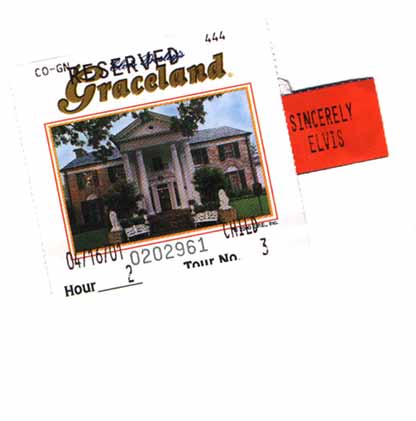



.jpg)